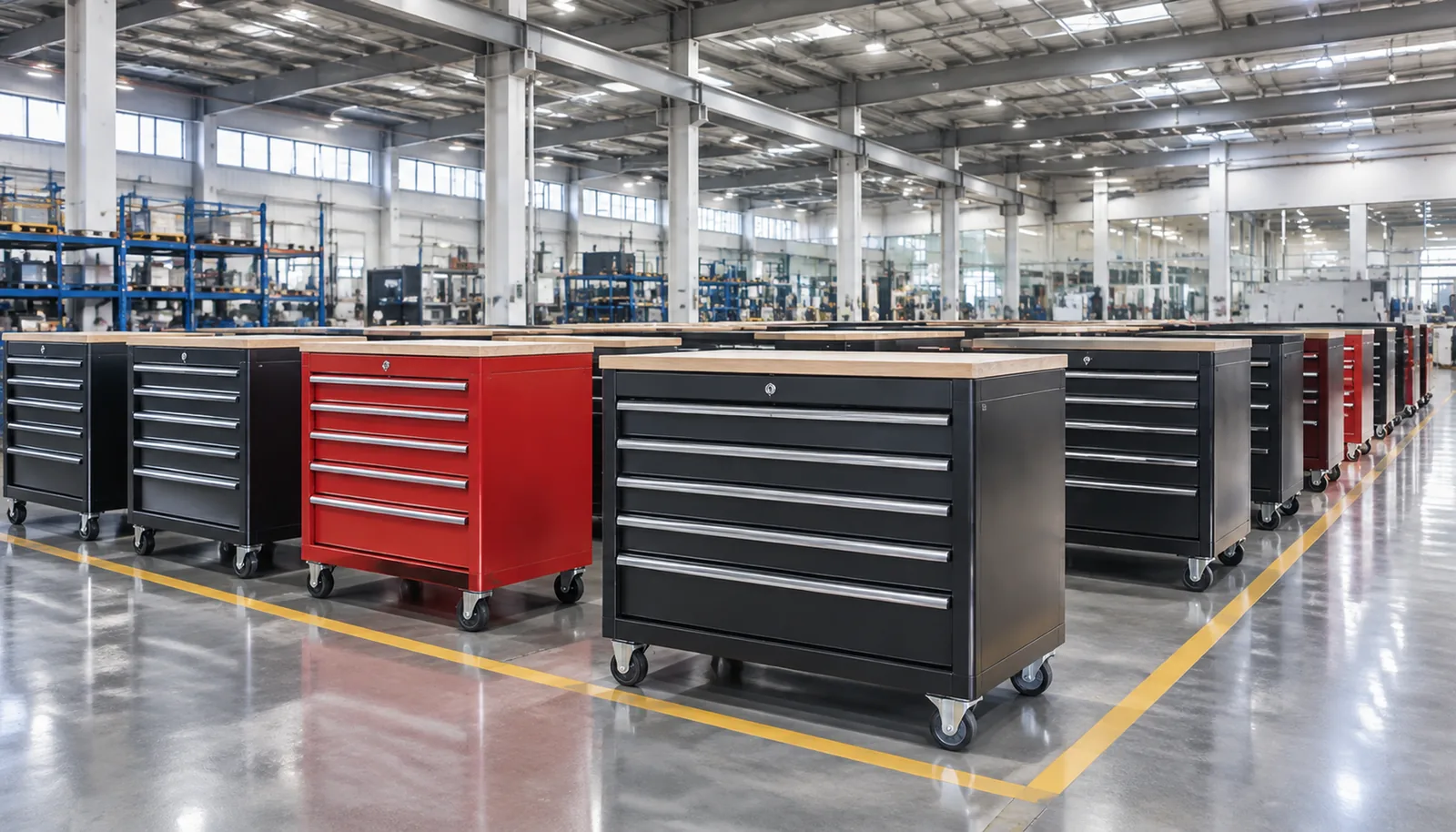
Vetting a supplier is rarely a question of "can they make a cabinet?" Almost any sheet metal shop can weld a box and fit drawers. What you need to know is whether the factory can hold the same steel thickness, slide performance, coating finish and packaging quality from your first sample to your fifth container, and whether someone on their side owns the problem when something goes wrong.
This guide gives distributors, importers and private-label brand owners a 12-point audit checklist to run before they commit to sampling. You can use it on-site, over a live video walk-through, or as the basis of a supplier questionnaire.
Looking for a factory rather than a checklist? See our tool cabinet manufacturer page for SAFEWELL's production base, product families, QC gates and how MOQ and lead time are set.
Why a structured audit matters for tool cabinets
Tool cabinets look simple, but they combine several processes that fail in different ways:
- Sheet metal forming and welding: this decides squareness, drawer fit and long-term rigidity.
- Surface finishing: powder coat adhesion and thickness decide whether the cabinet still looks premium after a year in a workshop.
- Purchased hardware: drawer slides, casters, locks and power modules are often bought in. Their consistency depends on the factory's incoming checks.
- Packaging: a 100 kg+ cabinet that arrives with a dented corner is a claim, a return and a lost dealer relationship.
A factory can be strong in one area and weak in another. The audit below checks each one separately.
The 12-point factory audit
1. Company background and product focus
Find out how long the factory has made tool storage specifically, not just sheet metal in general, and what share of its output is cabinets, carts and workbenches. Ask for the legal entity name that will appear on the invoice and export documents, and make sure it matches the factory you are auditing.
What good looks like: a clear company history, a defined tool-storage product range, and one legal entity from the quote to the bill of lading.
2. Quality, environmental and safety management systems
Ask for current ISO certificates. Check the certificate number, the issuing body, the scope wording and the expiry date on the certification body's own register. The scope should cover the design and manufacture of the products you are buying.
Red flag: the certificate belongs to a sister company or a trading office, not to the production site.
3. Raw material control (steel)
Cold-rolled steel thickness drives rigidity, weight and cost. Ask:
- Which steel grades and thicknesses are used for the body, drawer fronts and drawer boxes?
- How is incoming thickness verified (micrometer sampling, mill certificates, or both)?
- What tolerance is accepted, and what happens to out-of-tolerance coils?
Write the agreed thickness for each part into your spec sheet. "Heavy duty" on a quote is not a specification.
4. Cutting, punching and bending capability
Look at the equipment that forms your parts: laser cutting, CNC punching and CNC press brakes. Ask how bending programs are stored and how the first piece of each batch is checked against the drawing. Consistent bends mean drawers that run straight and doors that close flush.
5. Welding and structural assembly
Check the weld points on the cabinet frame, the caster mounting plates and the handle mounts. These are the high-stress points. Ask how weld quality is checked during production and whether there is a jig or fixture for each cabinet platform. Fixtures matter more than skill when you need repeatability.
6. Powder coating line and finish tests
Ask whether coating is automatic, manual or both, and which pre-treatment steps come before coating. Then ask which tests are run and how often:
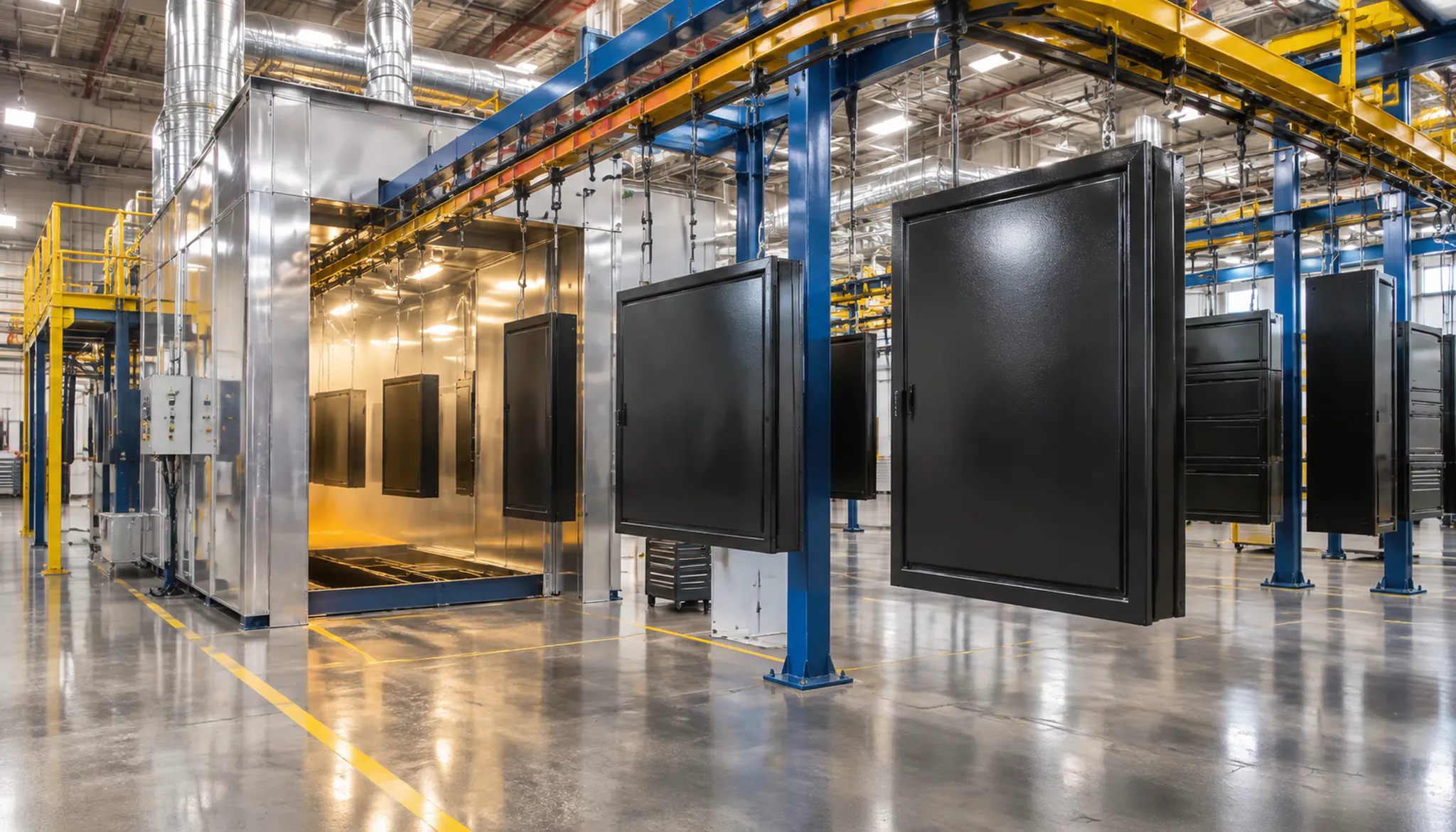
- Coating thickness measurement
- Adhesion (cross-cut) testing
- Corrosion resistance testing (for example salt spray), with the test duration stated
Agree on a color standard (RAL, Pantone or a physical master panel) and keep a signed panel on both sides.
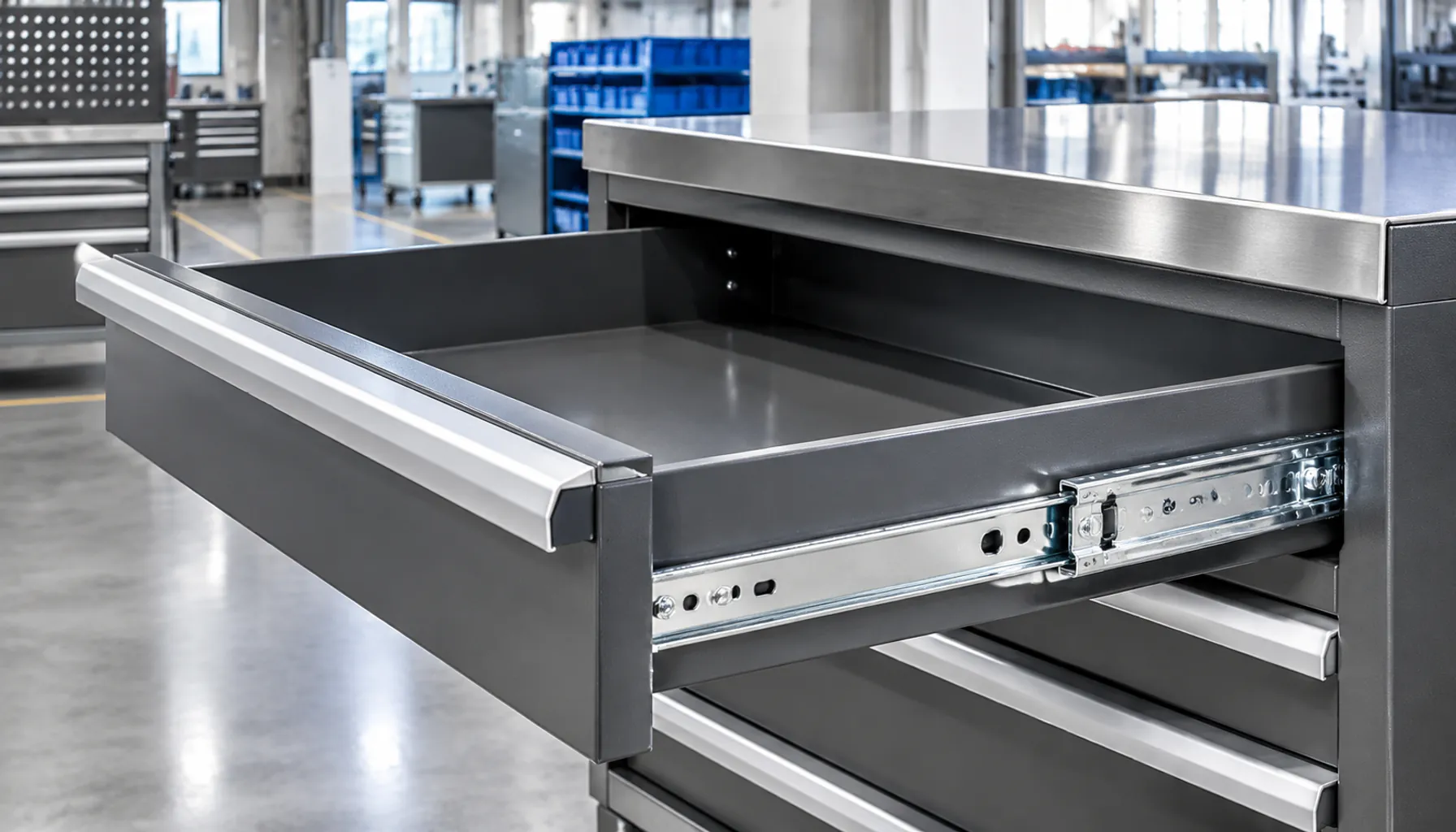
7. Drawer slide sourcing and function testing
Drawer slides are where most field complaints start. Confirm the slide type (ball-bearing, self-locking or soft-close), the rated load per drawer pair, and the extension length. Ask whether the factory runs open/close cycle tests or load tests on incoming slides and on finished cabinets. Ask to see the records, not just the procedure.
8. Casters, locks and electrical modules
For rolling cabinets, the caster diameter, wheel material, brake type and load rating per caster must match the total loaded weight, with a safety margin. For locks, confirm the lock type and the key or code management process. If the cabinet has a power strip or USB module, confirm the plug standard for each destination market and the certification route for that module. Ask which certificate covers the exact module and plug type you are buying, not just which certificates the company holds in general. At SAFEWELL, our power modules are UL and CE certified, and we can share the certificates for the module on your order.
9. In-process and final inspection gates
A mature tool cabinet manufacturer can name its inspection gates and show you the records for each one:
- IQC: incoming steel and hardware
- IPQC: dimensions and structure during forming, welding and assembly
- Coating QC: adhesion, thickness, corrosion
- Functional test: drawers, casters, locks, accessories
- FQC / OQC: final visual and structural check, plus packaging and order accuracy
Ask what the AQL sampling level is for final inspection, and whether you can bring a third-party inspector.
10. Packaging and transit protection
Heavy cabinets need corner protection, a stable base (often a pallet or reinforced bottom), and carton marks that warehouses can read. Ask whether drop or transit tests are run on new SKUs, and get photos of the packed unit, inside and outside, approved before the pilot run.
11. OEM/ODM engineering and change control
Find out whether your project is OEM on an existing platform or full ODM development. The answer changes MOQ, tooling cost and timeline. Ask how revisions are recorded: drawing revision numbers, a frozen bill of materials, and a signed "golden sample" for each SKU.
12. Communication, lead time ownership and issue response
Ask who your daily contact will be, how fast inquiries are answered, and who handles a quality claim from start to closure. Ask for the typical sample lead time and the mass-production lead time for your configuration. Make sure both are written into the PO.
Turning the audit into a scorecard
Score each of the 12 points from 1 to 5 and weight them for your business:
| Area | Suggested weight | Evidence to request |
|---|---|---|
| Material and forming (3-5) | 25% | Steel specs, first-article reports |
| Finish (6) | 15% | Coating test records, color master |
| Hardware and function (7-8) | 25% | Slide and caster specs, test logs |
| Inspection gates (9) | 15% | IQC/IPQC/OQC records for a recent batch |
| Packaging (10) | 10% | Packing photos, transit test results |
| Engineering and communication (11-12) | 10% | Revision log sample, response times |
A supplier that scores high on price but low on inspection gates will usually cost more over three orders than it saves on the first one. For a parallel checklist focused on tool boxes and OEM qualification, see our guide on how to qualify a tool box manufacturer for OEM programs.
FAQ
How many factory visits should we plan before approving a tool cabinet manufacturer? Most buyers plan one qualification audit before sampling and one pre-shipment or pilot-run inspection before the first volume order. A live video audit can replace the first visit if the factory shows the lines and QC stations in real time.
Is an ISO 9001 certificate enough to approve a supplier? No. ISO 9001 shows that a quality management system exists. You still need product-level evidence: incoming steel checks, slide and caster function tests, coating tests and final inspection records for your SKU.
What is the difference between OEM and ODM with a tool cabinet factory? OEM (private label) usually starts from an existing cabinet platform and changes the color, logo, lock, accessories and packaging. ODM means co-developing a new structure. That adds prototype rounds, production drawings and more validation time.
What should the first RFQ to a tool cabinet manufacturer include? Target market and plug standard, cabinet size and drawer layout, branding method and color, lock and caster type with the expected load, packaging and barcode rules, and your sample objective and shipment window.
Sources
- SAFEWELL homepage: https://www.swtoolstorage.com/
- SAFEWELL About: https://www.swtoolstorage.com/about/
- SAFEWELL OEM/ODM: https://www.swtoolstorage.com/oem-odm/
- SAFEWELL Contact: https://www.swtoolstorage.com/contact/
- ISO 9001 (iso.org): https://www.iso.org/standard/62085.html
Related Reading
Continue with a few closely related product, OEM, and comparison pages.
- Industrial Tool Cabinet Product Detail - Check core structure, drawer layout, and component specifications.
- Supplier Qualification Process - Understand factory qualification and program controls.
- Tool Box Wholesale Buying Checklist - Read another related article from SAFEWELL News.
- How to Launch a Tool Cart OEM Program - Read another related article from SAFEWELL News.
- OEM Tool Cart Supplier Audit Checklist for New B2B Buyers - Read another related article from SAFEWELL News.
Why SAFEWELL Is a Practical Fit
If you are adding a China-based supplier to your shortlist, here is what you can check about SAFEWELL against the audit above. Each point is backed by our published pages or by documents we can share during your audit, and the full overview is on our tool cabinet manufacturer page:
- Background: SAFEWELL was founded in 1998, giving us 28 years in the business, and has more than 8,000 employees globally. We manufacture tool cabinets, tool carts, workbenches, tool chests and tool boxes. See the history timeline on the About page.
- Management systems and certifications: we hold ISO 9001:2015, ISO 14001:2015 and ISO 45001:2018 certificates, and our homepage also lists UL, CE and SGS certifications. Ask us for copies during your audit so you can check the numbers, scope and expiry dates on the issuing bodies' registers, as point 2 recommends.
- Production base: a 16,000-square-meter facility with laser cutting, CNC punching, CNC press brakes, welding, and automatic and manual powder coating lines (homepage). We record a 98.7% on-time delivery rate.
- Inspection gates: IQC, IPQC, surface coating QC, assembly function control, FQC and OQC (homepage).
- OEM/ODM routes: private label OEM on existing platforms, full ODM development and contract manufacturing for running SKUs, with a published RFQ checklist and a six-step flow from requirement brief to delivery support (OEM/ODM page).
- Response: most standard inquiries get a first reply within one business day, and factory visits are available by appointment at our Jiashan, Zhejiang factory (Contact page).
Our tool cabinet manufacturer page explains that MOQ and lead time are set from the project scope after the sample is confirmed, that private-label work on an existing platform is quoted differently from full ODM. Many of our models are in stock and can be ordered as a single unit, which makes it easy to check build quality before you audit further. We also accept small-batch trial orders, so you can test a platform before committing to a full container. For volume orders, our standard MOQ is one 20GP container, and different models can be mixed in one container. We can also ship DDP (delivered duty paid) to the USA, Canada, Europe, Australia, New Zealand and South America, so the goods arrive at your door with customs clearance, duties and freight handled on our side. Send us your exact delivery address and we will confirm DDP for it. Samples are charged and typically take about 10 days, and mass production usually takes around 30 days after sample approval. The exact lead time depends on your configuration, so write it into the PO as point 12 recommends. On finish, our homepage describes a surface-coating quality stage that tests adhesion, thickness and corrosion resistance; ask for the target values and test records that apply to your program. On inspection, agree the AQL level and third-party inspection access in the purchase contract. Our product pages note that project files typically include inspection records, for example the LZ001 page.
The quickest way to test a factory is to send it a real brief. Share the following and we will reply with a product route, customization options and a preliminary quotation:
- Target market and plug standard (if the cabinet includes a power module)
- Cabinet size range and drawer configuration
- Branding method, color target and logo placement
- Lock type, caster type and expected load
- Packaging spec, barcode rules and accessory bundle
- Sample objective, approval route and target shipment window
Send your RFQ to the SAFEWELL project team, read our tool cabinet manufacturer overview, or review the OEM/ODM service tracks first if you are still choosing between private label and full ODM.
Prepared by SAFEWELL Industrial Content Team.