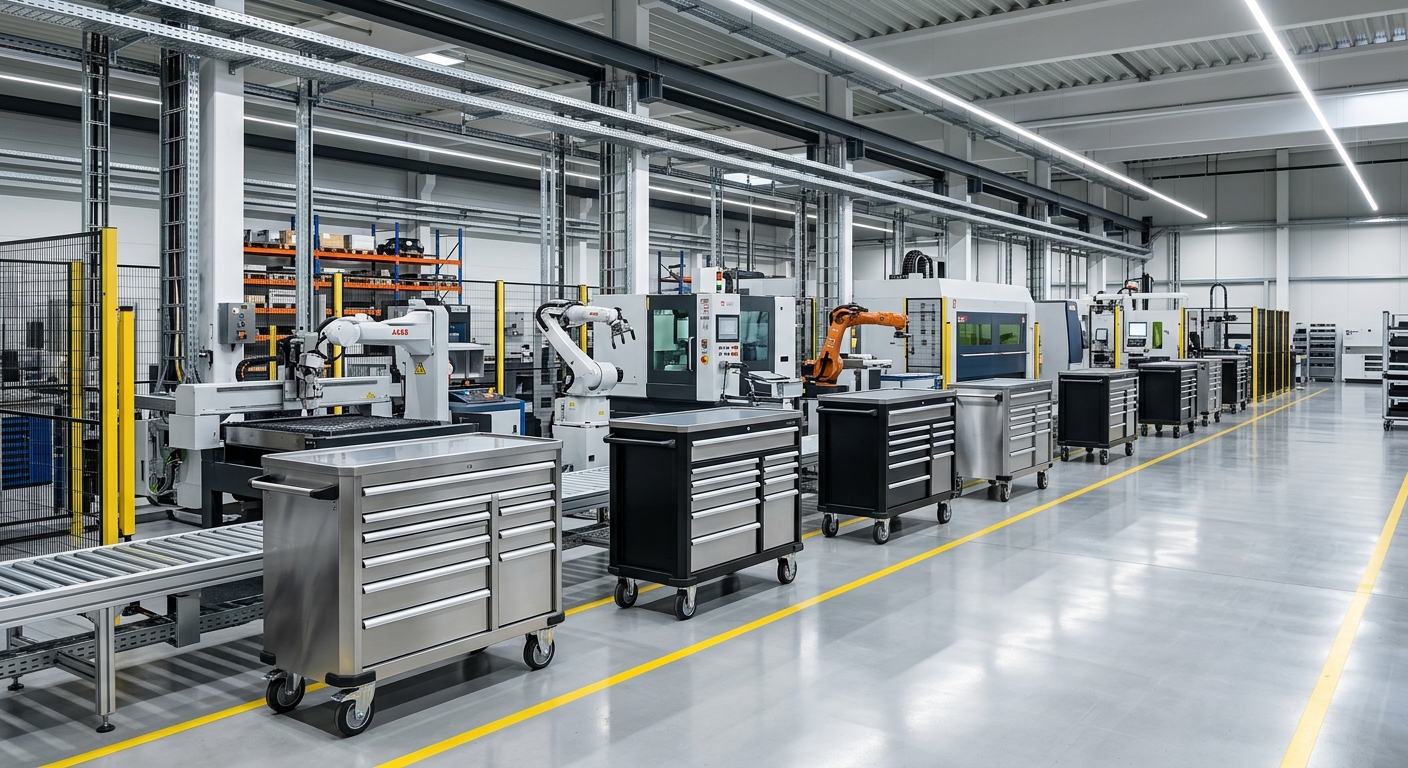
Launching a successful tool cart oem program requires moving past generic factory sourcing and establishing a rigorous, spec-driven procurement pipeline. Brand owners seeking private label tool storage solutions need a manufacturing partner who understands the nuances of heavy-duty fabrication, from steel gauge selection to export-grade packaging. A successful rollout moves methodically from initial RFQ and CAD design validation to physical sampling, mass production, and strict quality control.
Launch Priorities
- Sequence First: Establish a clear timeline from RFQ submission to pre-production sample (PPS) approval before discussing mass production lead times.
- Spec Freeze: Detail steel thickness, caster load ratings, and drawer slide mechanisms, locking these variables down early to prevent scope creep.
- Validation: Require physical testing for offset loads, rolling resistance, and weld fatigue prior to final sign-off.
- Launch Control: Define packaging standards, claims procedures, and spare-parts policies before the first container is loaded.
Engineering Out Field Failures in Your Tool Cart OEM Program
Market signals from end-users provide critical intelligence for B2B buyers structuring an RFQ. By analyzing real-world field discussions, warranty claims, and third-party reviews, brand owners can engineer out common flaws before mass production begins.
Field feedback from professional tradesmen frequently highlights the need to modify carts for flat-surface job sites or integrate modular storage boxes. There is high demand for specific organizational setups tailored to welding versus automotive tasks. This indicates a strong market for industrial tool trolley customization that accommodates aftermarket accessories and specialized workflows. Furthermore, users actively seek to identify legacy models to source replacement parts, meaning B2B buyers should ensure their custom tool cabinet manufacturer can provide long-term spare parts support.
Conversely, warranty data and field reports on low-cost ($100-$150) consumer-grade tool carts consistently expose critical failure points: flimsy custom drawer slides for tool carts, poor caster stability under offset loads, and severe shipping damage. While these are consumer products, they highlight the exact structural and logistical failures that B2B industrial buyers must actively avoid by partnering with a legitimate heavy duty tool cart supplier. Finally, procurement teams must vet suppliers rigorously; third-party review platforms frequently flag poor after-sales communication and unresponsive suppliers in the sourcing sector, underscoring the need for direct factory relationships and clear communication protocols.
SAFEWELL Launch Notes
Based on our experience managing global export workflows, we advise buyers to lock down the following parameters in writing before transferring any deposits. These proprietary notes are drawn directly from our OEM/ODM workflow to protect your margins and timeline.
MOQ and Spec-Lock Notes
- For brand owners and sourcing teams, the oem tool cart minimum order quantity should be confirmed at the SKU + finish + accessory-bundle level, not just at the broad product-family level.
- Freeze drawings, coating code, lock/caster configuration, carton spec, and spare-parts list before sample sign-off so late quote changes do not spill into lead time.
- If mixed-SKU or mixed-color loading matters, ask for the supplier's rule set up front instead of assuming the first MOQ applies to every combination.
QC Watchpoints Buyers Should Put in Writing
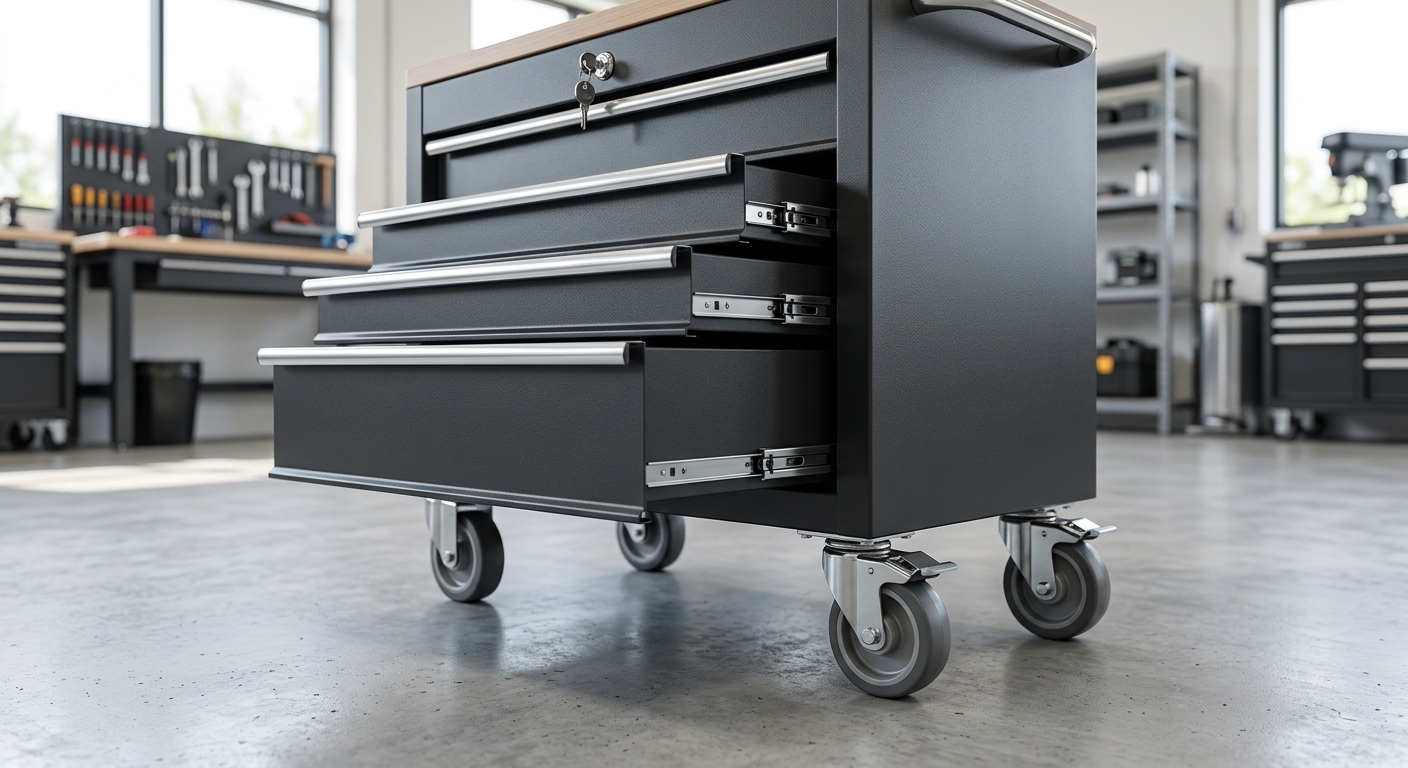
- Do not approve the RFQ until the supplier agrees on critical-to-quality items such as caster brake consistency, rolling resistance, and weld fatigue around the handle/caster plate.
- Ask for photo or video evidence for cart stability under offset loads and over uneven workshop floors, because these are exactly the items that tend to trigger claims later.
- Agree on who signs off IQC / IPQC / OQC checkpoints and which defects count as claimable, rather than leaving that decision to the factory floor at shipment time to maintain strict tool cart quality control standards.
Packaging and Claims Pitfalls
- Treat packaging as a commercial-risk topic, not a late-stage admin task. Corner crush, drawer-face rubbing, and hardware damage usually become margin problems, not just warehouse problems.
- Define a claims pack in advance: batch reference, photos, response window, spare-parts policy, and credit/replacement path. This shortens after-sales friction when defects appear.
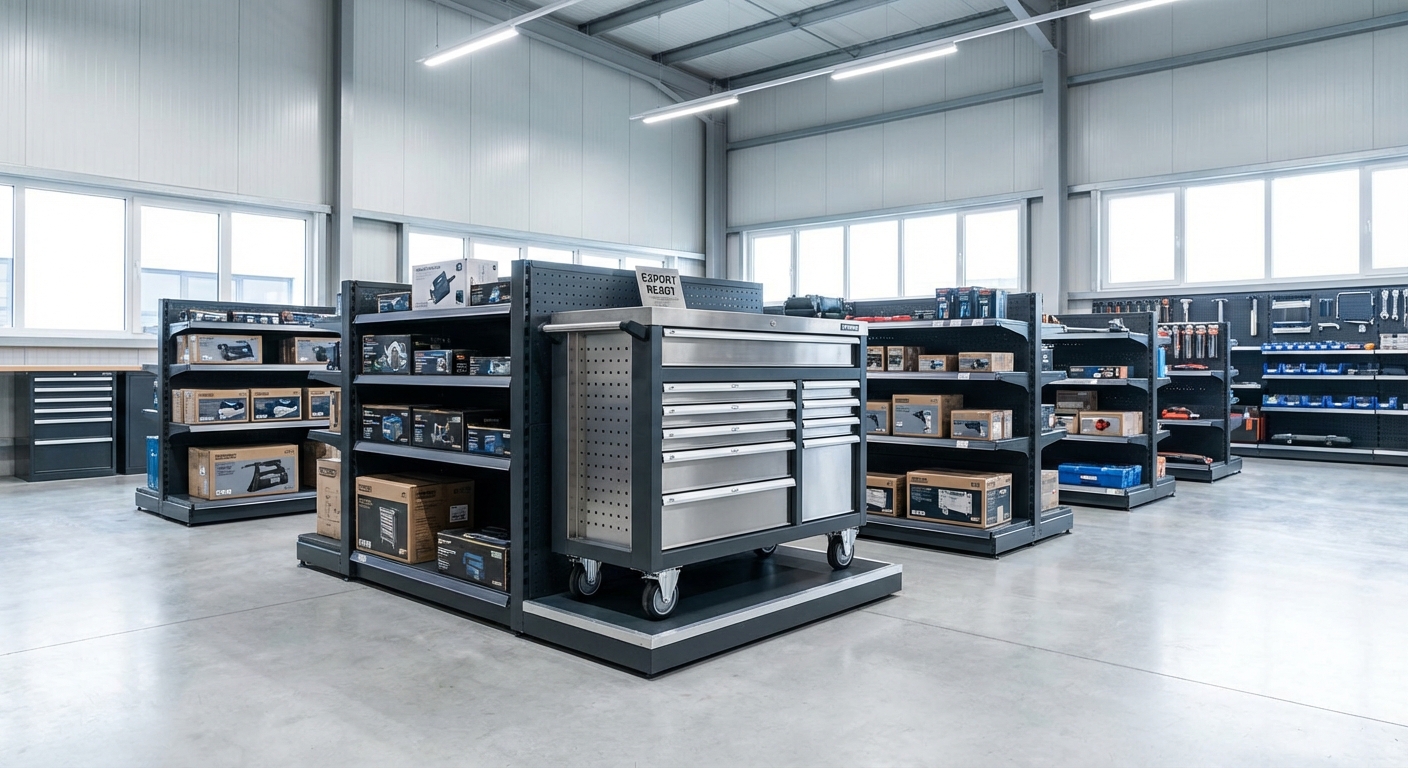
- If the order is export-facing, confirm carton strength, pallet rules, moisture protection, and movement restraint for tool cart packaging and shipping before the first container leaves the plant.
Program Readiness Scorecard
Selecting the right partner is the most critical step in your sourcing journey. Use this weighted scorecard to objectively evaluate potential suppliers based on their capabilities, quality management, and financial stability.
| Evaluation Criteria | Weight | Description | Minimum Acceptable Score (1-10) |
|---|---|---|---|
| Manufacturing Capability | 30% | In-house laser cutting, CNC bending, and automated robotic welding. | 8 |
| Quality Management | 25% | ISO 9001 certification, dedicated QC staff, and inline inspection protocols. | 8 |
| Customization Flexibility | 20% | Ability to modify dimensions, steel gauge, and integrate custom hardware. | 7 |
| Production Capacity | 15% | Monthly output volume and ability to scale during peak seasons. | 7 |
| Packaging & Logistics | 10% | Experience with ISTA drop-test standards and export-grade packaging. | 8 |
OEM Program Checklist
To ensure a smooth procurement cycle and minimize risks, follow this comprehensive checklist when sourcing oem tool storage equipment:
- RFQ Preparation: Provide detailed CAD drawings, a comprehensive BOM, and target pricing expectations upfront.
- Component Specs: Specify exact steel gauges, caster types (e.g., TPR, PU), and load capacities for drawer slides.
- Finish Requirements: Define exact RAL colors, gloss levels, and texture profiles for custom powder coated tool cabinets.
- Sampling Protocol: Require a pre-production sample (PPS) for physical sign-off before authorizing mass production.
- Durability Testing: Conduct salt spray tests on the powder coating and cycle tests on the drawer slides to verify longevity.
- Inline QC: Implement inline inspections at the welding, painting, and final assembly stages.
- Final Inspection: Mandate AQL (Acceptable Quality Limit) standards, typically setting 1.5 for major defects and 4.0 for minor defects.
- Factory Compliance: Verify the factory's ISO 9001 certification for quality management systems.
- Transit Protection: Require ISTA-certified drop testing for all packaging to mitigate transit damage.
- Spare Parts: Negotiate terms for a percentage of replacement parts (e.g., spare casters, locks, or slides) to be included in the shipping container.
Questions Buyers Ask Before Launch
What steel gauge is recommended for industrial tool cart OEM manufacturing?
For professional and industrial applications, 18-gauge to 20-gauge cold-rolled steel (SPCC) is standard for the main body, while 16-gauge is often used for reinforced bottom panels and caster mounting plates to prevent structural warping under heavy loads.
How can brand owners protect their IP when customizing tool carts?
Sign a Non-Disclosure Agreement (NDA) and a Non-Compete Agreement (NNN) before sharing proprietary CAD files or custom extrusion designs. Ensure the supplier has a strict internal policy against showcasing your custom molds or branded samples in their public catalog.
What is the standard lead time for a new private label tool cart program?
Initial tooling and pre-production sampling typically take 25 to 40 days. Once the sample is approved, mass production usually requires 35 to 50 days, depending on the complexity of the custom powder coating and hardware procurement.
How should buyers validate lead time for tool cart OEM orders?
Lead time should be checked against confirmed capacity, material readiness, sample approval timing, and peak-season risk. Buyers should ask what specific design changes or material shortages trigger a new production schedule.
What MOQ assumptions should buyers confirm before launching a tool cart oem program?
Buyers should confirm MOQ at the SKU, finish, and accessory-bundle level rather than assuming one product-family MOQ applies to every combination. This avoids late quoting changes and mixed-load misunderstandings.
Which QC checkpoints matter most when approving a tool cart oem supplier?
The RFQ should define incoming, in-process, and outgoing checks, plus who signs off on drawer alignment, weld consistency, finish quality, hardware fit, and packaging condition before shipment.
Verification Standards & References
- ISO 9001: Quality management systems requirements for manufacturing facilities. ISO 9001
- BIFMA: Often referenced for drawer slide cycle testing and load capacity standards. BIFMA
- ISTA: International Safe Transit Association standards for packaging drop tests and transit simulation. ISTA
- ASTM International: Standards for steel sheet specifications and powder coating adhesion testing. ASTM
Related Reading
Continue with a few closely related product, OEM, and comparison pages.
- Tool Cart Solutions - Review rolling cart options and capacity classes.
- Supplier Qualification Process - Understand factory qualification and program controls.
- Tool Box Wholesale Buying Checklist - Read another related article from SAFEWELL News.
- Heavy Duty Tool Storage Systems: Industrial Buyers Guide - Read another related article from SAFEWELL News.
Where SAFEWELL Helps Programs Launch Cleanly
For brand owners looking to scale their private label mechanic tool carts, SAFEWELL provides a reliable, high-capacity manufacturing foundation tailored to B2B procurement needs.
- OEM/ODM Core Advantage: We offer end-to-end customization from sheet metal fabrication to final assembly, ensuring your tool carts match your exact brand specifications without forcing you into off-the-shelf compromises.
- Advanced Manufacturing: Our facilities are equipped with automated laser cutting, CNC bending, and robotic welding for precise, repeatable production at scale.
- Robust Quality Control: We utilize in-house testing facilities to verify drawer load capacity, powder coat durability, and caster performance before shipment.
- Scalable Production: We offer flexible MOQs and high-capacity production lines designed to support both emerging private labels and established global brands.
- Export-Ready Packaging: Our proven packaging solutions are engineered to withstand international shipping stresses, drastically reducing transit damage rates and protecting your margins.
Transitioning from concept to a market-ready product requires precise execution and a reliable manufacturing partner. Consolidate your CAD files, material specifications, and target volumes, and reach out to our engineering team to initiate your RFQ and begin the sampling process today.
Contact SAFEWELLPrepared by SAFEWELL Industrial Content Team and reviewed against SAFEWELL buyer-support and manufacturing workflow team.