
For industrial distributors, brand owners, and engineering project managers, sourcing tool box wholesale requires more than just comparing unit prices. When evaluating tool box supplier replacement, the focus must shift from basic unit cost to total landed cost, supply chain reliability, and defect prevention. This comprehensive industrial tool storage procurement guide provides the framework needed to assess factory capabilities, standardize quality control, and protect your margins from costly manufacturing disruptions.
Buying Priorities
- Shortlist tool box wholesale suppliers who can document performance specs (load rating, coating system, spare parts plan), not just brochure claims.
- Lock down an OEM/ODM spec pack before sampling: dimensions, drawer layout, locks, accessories, color, logo placement, and packaging.
- Validate QC checkpoints (incoming, in-process, final) and define accept/reject rules to reduce batch-to-batch drift.
- Confirm MOQ, lead time, and change-control rules in writing (material substitutions, versioning, and tolerance limits).
- Use a weighted audit scorecard so procurement and engineering align on tradeoffs (cost, durability, compliance, delivery risk).
Tool Box Wholesale Buying Priorities
Before engaging a new factory, procurement teams should establish clear decision filters to separate capable OEM partners from basic trading companies:
- Total Landed Cost Over Unit Price: Factor in defect rates, packaging upgrades, and freight efficiency when comparing quotes.
- Structural Integrity: Define exact steel gauges and load capacities to separate professional-grade storage from consumer-tier products.
- Traceable Quality Control: Mandate documented incoming, in-process, and outgoing inspections.
- Commercial Risk Mitigation: Treat packaging and claims policies as critical contract terms, not afterthoughts.
Questions Buyers Ask Before Approval
How do end-user demands impact B2B specifications?
Market feedback from retiring mechanics and automotive students consistently highlights the gap between hobbyist storage and professional-grade equipment. End-users actively debate the limitations of 19-gauge steel for daily use, emphasizing that premium heavy-duty brands hold significant long-term resale value. B2B buyers must engineer their RFQs to meet these professional expectations rather than settling for consumer-grade materials.
What mechanical vulnerabilities trigger the most claims?
Feedback on retail platforms frequently exposes mechanical vulnerabilities in entry-level kits—specifically weak drawer slides, poor latch alignment, and inadequate caster load ratings. While buyers often focus their search demand on tool box price, failing to specify heavy-duty ball-bearing slides and reinforced chassis designs inevitably leads to high return rates and margin erosion.
How should buyers validate lead time for wholesale orders?
Lead time should be checked against confirmed factory capacity, raw material readiness, sample approval timing, and peak-season shipping risks. Buyers should explicitly ask what design or packaging changes will trigger a new production schedule to avoid unexpected delays.
What is the best way to handle mixed-load container shipments?
Buyers should confirm MOQ at the SKU, finish, and accessory-bundle level rather than assuming one broad product-family MOQ applies to every combination. Establishing the supplier's rule set for mixed-SKU or mixed-color loading upfront prevents late quoting changes and container optimization issues.
What MOQ assumptions should buyers confirm before launching a tool box wholesale program?
Buyers should confirm MOQ at the SKU, finish, and accessory-bundle level rather than assuming one product-family MOQ applies to every combination. This avoids late quoting changes and mixed-load misunderstandings.
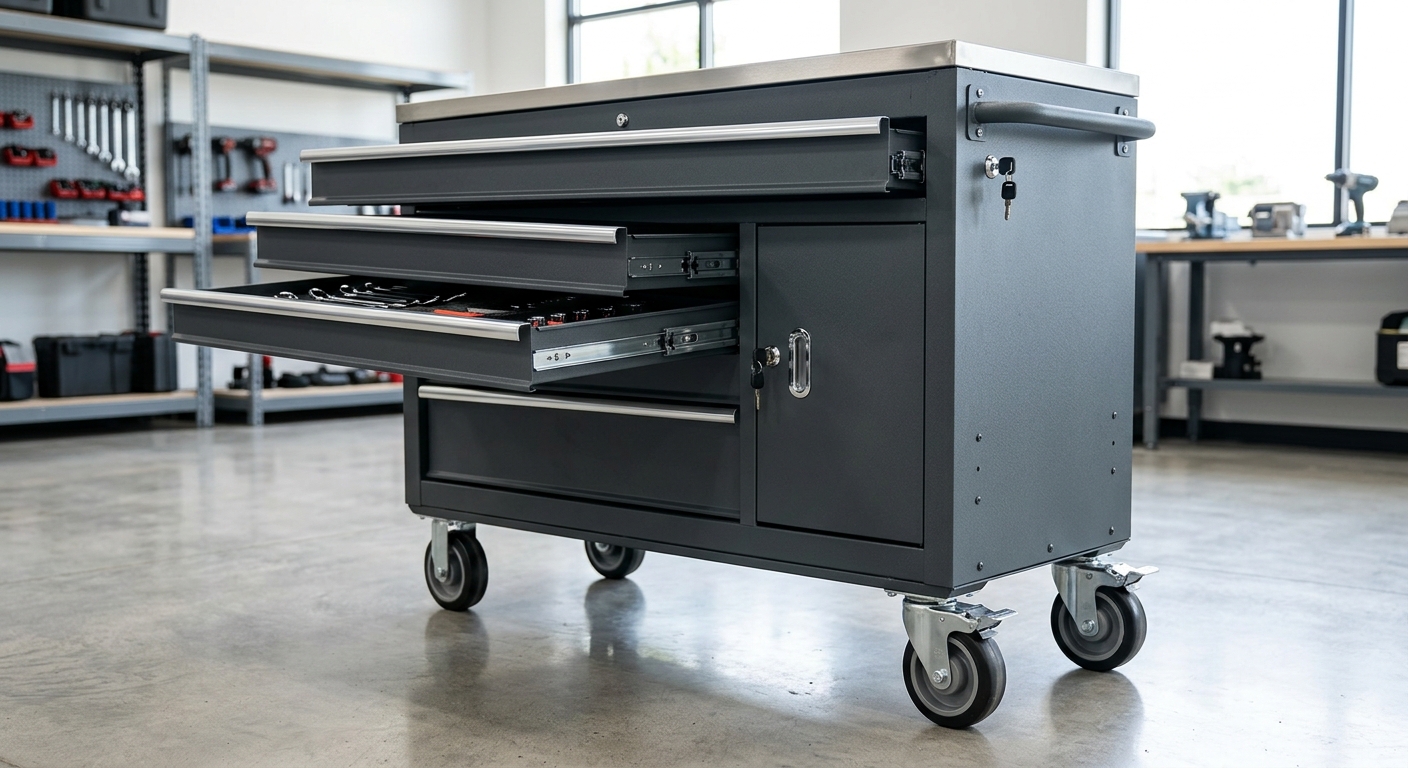
Which QC checkpoints matter most when approving a tool box wholesale supplier?
The RFQ should define incoming, in-process, and outgoing checks, plus who signs off on drawer alignment, weld consistency, finish quality, hardware fit, and packaging condition before shipment.
SAFEWELL Buyer Checklist Notes
Drawing from our daily OEM/ODM and export workflows, here are the critical watchpoints buyers must manage when sourcing tool storage. These proprietary insights help prevent the most common friction points between buyers and factories.
MOQ and Spec-Lock Notes
- For industrial distributors, MOQ should be confirmed at the SKU + finish + accessory-bundle level, not just at the broad product-family level.
- Freeze drawings, coating code, lock/caster configuration, carton spec, and spare-parts list before sample sign-off so late quote changes do not spill into lead time.
- If mixed-SKU or mixed-color loading matters, ask for the supplier's rule set up front instead of assuming the first MOQ applies to every combination.
QC Watchpoints Buyers Should Put in Writing
- Do not approve the RFQ until the supplier agrees on critical-to-quality items such as latch/hinge consistency, handle durability, and internal tray fit after transit.
- Ask for photo or video evidence for corner protection and packaging rigidity for dent-sensitive surfaces, because these are exactly the items that tend to trigger claims later.
- Agree on who signs off IQC / IPQC / OQC checkpoints and which defects count as claimable, rather than leaving that decision to the factory floor at shipment time.
Packaging and Claims Pitfalls
- Treat packaging as a commercial-risk topic, not a late-stage admin task. Corner crush, drawer-face rubbing, and hardware damage usually become margin problems, not just warehouse problems.
- Define a claims pack in advance: batch reference, photos, response window, spare-parts policy, and credit/replacement path. This shortens after-sales friction when defects appear.
- If the order is export-facing, confirm carton strength, pallet rules, moisture protection, and movement restraint before the first container leaves the plant.
Buyer Checklist
To streamline your purchasing process and mitigate risks, follow this comprehensive wholesale tool box quality control checklist when engaging with a new manufacturer.
- RFQ Specifications: Detail exact overall dimensions, steel gauge, and drawer configurations to build a reliable baseline for heavy duty steel tool chest manufacturing.
- Factory Audits: Utilize strict OEM tool box factory audit criteria focusing on ISO 9001 compliance, actual production capacity, and raw material traceability.
- Coating Specifications: Enforce strict powder coating standards for metal tool boxes, specifying a minimum thickness of 60-80 microns and verified salt spray testing.
- In-Line Inspection (DUPRO): Require third-party or documented internal inspections at the 20% completion mark to catch early defects.
- Export Packaging: Specify ISTA-certified drop-tested packaging, honeycomb cardboard, and reinforced corners to ensure tool box packaging for international freight survives transit.
- Container Loading: Request 3D loading plans to optimize global shipping for bulk tool storage without exceeding weight limits or risking crush damage.
- Lead Time Management: Contractually define acceptable delivery windows and establish buffer stock agreements to stabilize supply.
- Warranty Terms: Document the exact B2B tool box warranty and claims process, specifying the required evidence and the timeline for receiving replacement parts.
- Pricing Strategy: Ensure rolling tool cabinet wholesale pricing is locked in for a defined period to protect against sudden raw material fluctuations.
- Supplier Consistency: Follow a standardized checklist for every batch, ensuring consistency across all bulk tool box suppliers for distributors.
Supplier Comparison Matrix
Use the following weighted scorecard to objectively evaluate suppliers during the auditing phase.
| Audit Criteria | Weight | Minimum Acceptable Standard | Evaluation Method |
|---|---|---|---|
| Manufacturing Automation | 25% | CNC bending & robotic welding present | On-site video tour / 3rd party audit |
| Quality Control Systems | 20% | ISO 9001 certified, documented IQC/OQC | Certificate verification & SOP review |
| Material Traceability | 15% | Mill test certificates for steel coils | Document review during audit |
| Customization (OEM/ODM) | 20% | In-house CAD/CAM engineering team | Review of past custom project portfolios |
| Packaging & Loading | 20% | ISTA-compliant drop-tested packaging | Pre-shipment inspection (PSI) reports |
Standards and Verification References
Ensure your supplier adheres to recognized international standards to guarantee product safety, durability, and compliance.
- ISO 9001 Quality Management Systems - Baseline for factory quality control and operational consistency.
- ASTM B117 Salt Spray Testing - Standard practice for evaluating the corrosion resistance of powder coatings.
- ISTA Packaging Standards - Guidelines for testing packaging to withstand the rigors of international transit.
- BIFMA Standards - Industry protocols often adapted for testing heavy-duty drawer slides and cabinet stability.
- Mechanic Retiring - Resale Value Discussions - Real-world buyer signals on professional tool box longevity.
- Weekend Warrior vs Professional Gauge Debates - End-user feedback on steel gauge requirements.
Related Reading
Continue with a few closely related product, OEM, and comparison pages.
- Tool Box Product Line - See toolbox variants for distribution and OEM programs.
- OEM/ODM Program Overview - Review manufacturing workflow, sampling, and quality checkpoints.
- How to Launch a Tool Cart OEM Program - Read another related article from SAFEWELL News.
- Heavy Duty Tool Storage Systems: Industrial Buyers Guide - Read another related article from SAFEWELL News.
Where SAFEWELL Helps Buyers Keep Approval Clean
For industrial distributors and engineering brands seeking a reliable manufacturing partner, SAFEWELL offers a highly structured, risk-averse approach to industrial tool storage procurement.
- OEM/ODM Customization: Dedicated engineering teams are available to modify dimensions, drawer layouts, and branding to match your exact market specifications and project requirements.
- Advanced Manufacturing: In-house automated laser cutting, robotic welding, and environmentally controlled powder coating lines ensure consistent, export-grade quality across every batch.
- Scalable Production: High-capacity facilities capable of handling large-volume distributor orders while maintaining stable and predictable lead times, even during peak seasons.
- Export-Ready Packaging: Proven packaging solutions designed to maximize container space, comply with ISTA standards, and eliminate transit damage, protecting your bottom line.
Ready to upgrade your tool storage supply chain and eliminate procurement bottlenecks? Compile your technical specifications, required MOQs, and branding guidelines, and reach out to the SAFEWELL team to initiate your RFQ. Our engineers will provide a detailed technical proposal, transparent pricing, and a reliable production timeline tailored to your distribution needs.
Contact SAFEWELL