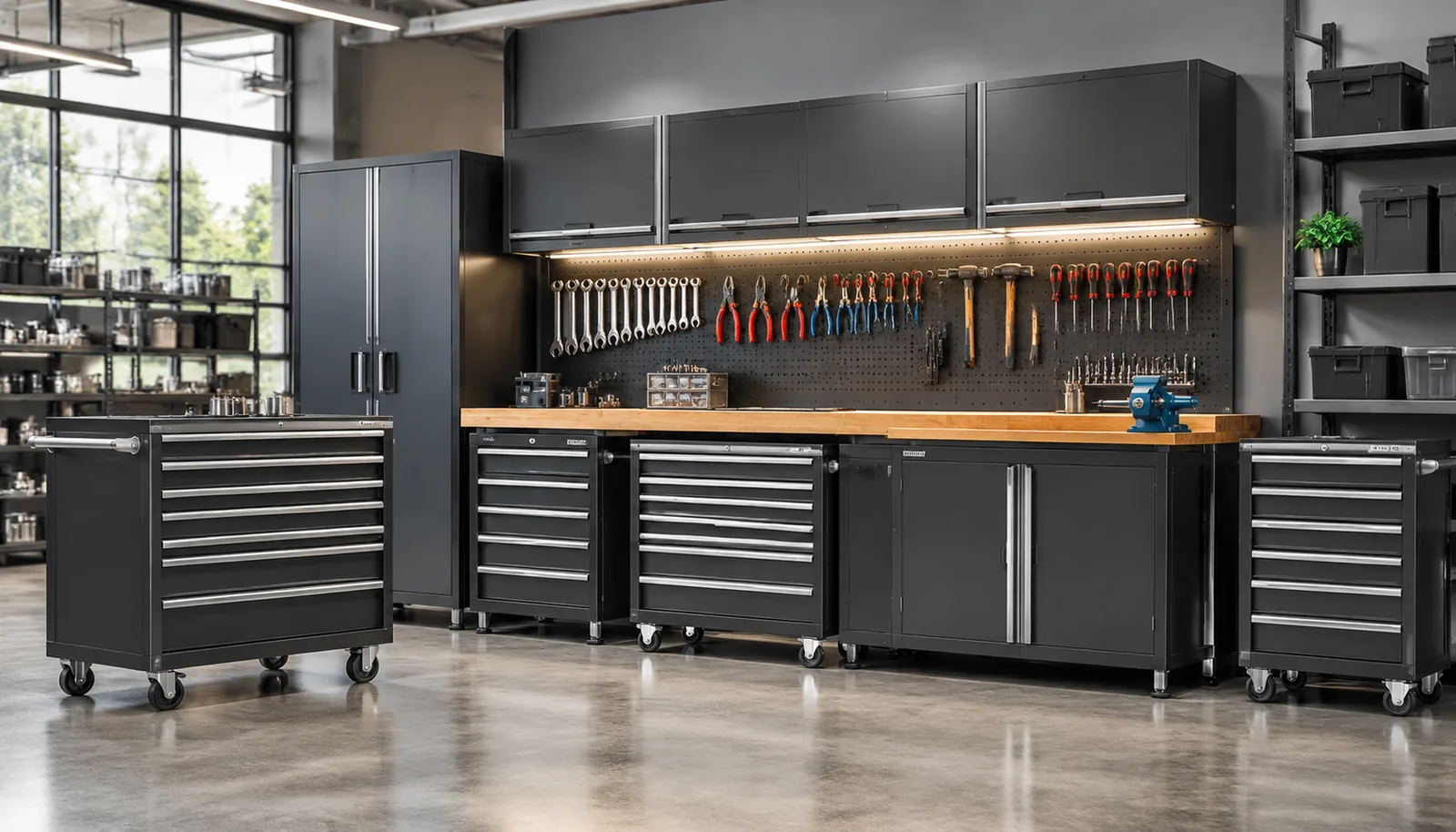
Buyers searching for the best tool storage system are rarely looking for a single product. In a professional workshop the system is usually a set of modules: a rolling tool cabinet as the core, sometimes combined with a top chest, side cabinet, a mobile workbench from a custom workbench manufacturer, or wall storage. The "best" system is the one whose core cabinet survives daily use under real loads. For a broader overview of system types, see our heavy duty tool storage systems buyers guide. This article goes one level deeper into the cabinet itself.
A rolling tool cabinet holds heavy tools, gets pushed across rough floors and has its drawers opened hundreds of times a day. When it fails, it usually fails in one of four places: the steel, the drawer slides, the load rating or the casters.
This guide is for distributors, dealer buyers and private-label brand owners comparing tool storage systems from different suppliers. It explains how to read each spec, which questions to ask a tool cabinet manufacturer, and what to put in the RFQ so quotations are comparable.
How to compare tool storage systems: four specs that matter most
| Spec | What to compare | Typical red flag |
|---|---|---|
| Steel thickness | mm per part (body, drawer, base) | Only one number for the whole cabinet |
| Drawer slides | Type, rating per drawer, cycle test | Rating with no test basis |
| Load | Per-drawer vs total vs rolling load | Totals that do not add up |
| Casters | Diameter, wheel material, brakes, rating per caster | Casters rated below loaded weight / 3 |
1. Steel gauge: read it in millimeters
Suppliers in different markets describe sheet steel in different ways. North American catalogs often use gauge numbers, while a China tool cabinet supplier usually quotes thickness in millimeters, for example "T1.0" or "T1.5". Under the common manufacturers' standard gauge for sheet steel, the approximate equivalents are:
| Gauge | Approx. thickness | Typical use in a rolling cabinet |
|---|---|---|
| 20 ga | ~0.9 mm | Light drawer bodies, budget lines |
| 19 ga | ~1.0-1.1 mm | Drawer bodies, side panels |
| 18 ga | ~1.2 mm | Drawer fronts, panels on pro-grade units |
| 16 ga | ~1.5 mm | Frames, base, caster mounting areas |
| 14 ga | ~1.9 mm | Heavy industrial frames and bases |
A lower gauge number means thicker steel. Three practical rules:
- Specify thickness per part, not per cabinet. "1.0/1.5 mm" usually means thinner steel in some areas and thicker steel in others. Ask which parts get which thickness.
- Ask about tolerance. Cold-rolled sheet has a thickness tolerance. Agree on the minimum acceptable value and how incoming steel is checked.
- Look at structure, not just thickness. Folded edges, internal reinforcement and welded corners can add more rigidity than an extra 0.2 mm of steel.
For reference, the LZ001 Professional Rolling Tool Cabinet is listed with T1.0/1.5 cold-rolled steel and electrostatic powder coating. The LZ002-02 Heavy Duty Tool Cabinet (15 Drawers) is listed with T1.2/T1.5 construction. Neither page breaks thickness down by part, so ask any supplier for a per-part steel schedule.
2. Drawer slides: rating, type and extension
Slides decide how the cabinet feels to the end user, and they cause most warranty complaints. Check four things.
Slide type. Ball-bearing slides are the norm for professional rolling cabinets. Friction slides are cheaper but wear faster under load. Self-locking (detent) slides keep drawers closed when the cabinet is moved. That matters for a cabinet that rolls.
Load rating. A rating such as "100 lb" is normally quoted per drawer, meaning per pair of slides, at full extension. Conventions differ, so ask the supplier to confirm:
- whether the rating is per drawer or per slide,
- whether it is a static or a cycling load,
- how many open/close cycles the slides were tested for, and at what load.
Extension. Full-extension slides let users reach the back of the drawer. Check whether wide or deep drawers use the same slide as small ones, or a heavier one.
Upgrade paths. Many programs offer a standard rating and an upgrade for deep drawers. LZ001 is listed with 100 lb ball-bearing self-locking slides (product page). LZ002-02 is listed with 100 lb slides and an optional 150 lb version (product page). Before sample approval, ask for the cycle-test method and results at the rated load. Our homepage lists a functional test stage for drawers, casters and locks.
3. Load: total capacity vs. drawer capacity
Buyers often compare cabinets on a single "capacity" number, but there are at least three different loads:
- Per-drawer load: limited by the slide rating and drawer bottom stiffness.
- Total cabinet load: the structure plus casters, usually the number quoted as "total capacity".
- Dynamic load while rolling: the stress on the casters and mounting plates when a loaded cabinet is pushed over joints, ramps or cables. This is harder on the cabinet than standing still.
When you compare suppliers, ask how each number was measured and whether total capacity was rated as a static or a rolling load. Also check that the numbers add up: ten drawers at 100 lb each with a 350 kg total rating means the full cabinet cannot hold every drawer at its maximum at once.
From the product pages:
- LZ001: 350 kg total capacity, size (685+95) x 480 x 980 mm, net/gross weight 85/100 kg (product page). The 350 kg figure comes from the product feature list.
- LZ002-02: total capacity up to 690 kg, size 1433 x 660 x 1180 mm, net/gross weight 210/275 kg (product page). The page does not say whether this is a static or a rolling rating. Ask any supplier for the test basis before comparing totals.
4. Casters: diameter, material, brakes and margin
Casters turn a tool cabinet into a rolling tool cabinet. They are also where heavy units most often fail in the field. For a deeper look at failure modes, see our article on how to prevent tool cart caster failure in high-load workshops.
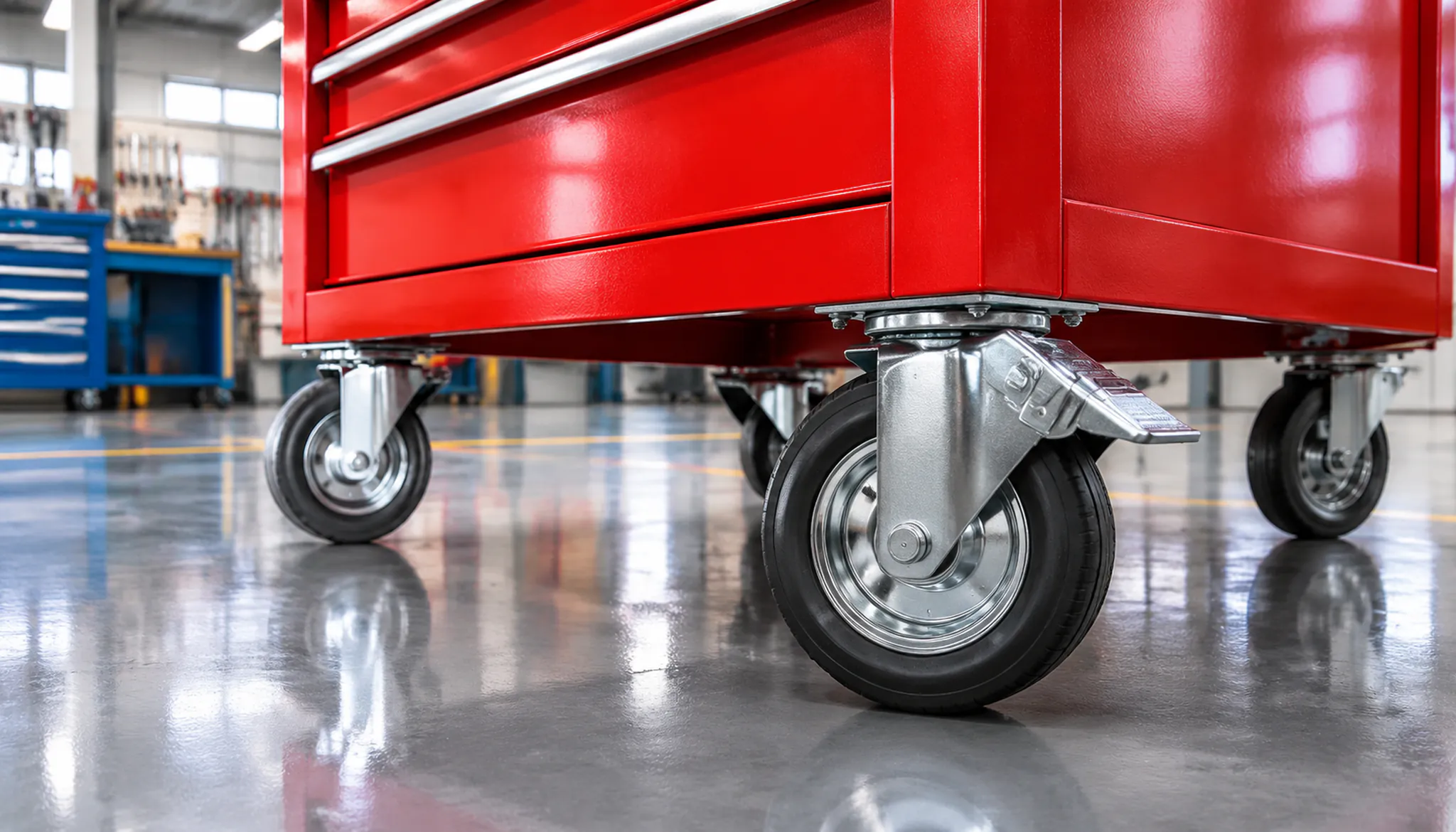
Diameter. Larger wheels roll more easily over expansion joints, cables and debris. Five-inch and six-inch casters are common on full-size rolling cabinets.
Wheel material. Rubber and TPR wheels are quieter and protect floors. Polyurethane resists wear and chemicals. Choose based on the customer's floor and environment.
Swivel and brake layout. A common layout is four swivel casters with two braked. Some buyers prefer two swivel and two rigid casters for straight-line stability on long pushes. Total-lock brakes (wheel and swivel) hold better than wheel-only brakes.
Load margin. A simple sizing rule: take the fully loaded weight (cabinet empty weight plus expected tool load) and divide it by three casters, not four. On an uneven floor one caster is often barely touching. Then add a safety margin.
Mounting. Check the steel thickness and reinforcement where the casters bolt on. A good caster on a thin base plate still fails.
From the product pages: LZ001 uses 5 x 2" swivel casters, two with brakes. LZ002-02 uses 6" 360° silent rubber swivel casters, two with brakes. Neither page lists a per-caster rating, so ask for it and check it against the loaded-weight-divided-by-three rule above. Our OEM/ODM page lists caster material, brake type, wheel size and load matching as configurable items.
5. Locks, finish and accessories
These are not part of this guide's four core specs, but they belong in the same RFQ:
- Lock type: LZ001 is listed with a flat lock. Smart locks with keypad or fingerprint are offered as a customization option on the OEM/ODM page.
- Finish: ask for powder coating thickness, adhesion and corrosion test methods. Our homepage describes a coating QC stage testing adhesion, thickness and corrosion resistance; ask for the target values and test records for your program.
- Accessories: LZ001 includes 3.0 mm EVA drawer mats. LZ002-02 includes a top PC board with integrated red and white light strips and a standard 4-plug PDU (product page). The OEM/ODM page lists side-mounted PDU + USB options with US, UK, EU or AU plug standards. SAFEWELL power modules carry UL and CE certification. For any power module, still ask the supplier for the certificate that covers that exact module and plug type for your destination market.
6. Rolling tool cabinet RFQ checklist
Copy this into your RFQ so every supplier quotes against the same baseline:
- Overall size (W x D x H) and drawer count and layout
- Steel thickness per part: body, drawer front, drawer body, base
- Slide type, rated load per drawer, extension and cycle-test requirement
- Total static load and any rolling-load requirement
- Caster diameter, wheel material, swivel/brake layout and rated load per caster
- Lock type and key or code management
- Coating color standard, thickness and test requirements
- Accessories: drawer liners, worktop, power module and plug standard, lighting
- Packaging: corner protection, pallet or base, carton marks and barcodes
- Sample objective, approval route and shipment window
Buying One Cabinet or Selling Online: Single Units, Dropshipping and DDP
Not every buyer needs a container. If you are equipping your own garage or workshop, many SAFEWELL models are in stock and can be ordered as a single unit. With DDP (delivered duty paid) shipping, we handle freight, customs clearance and duties, and the cabinet is delivered to your door, so you simply wait for it to arrive.
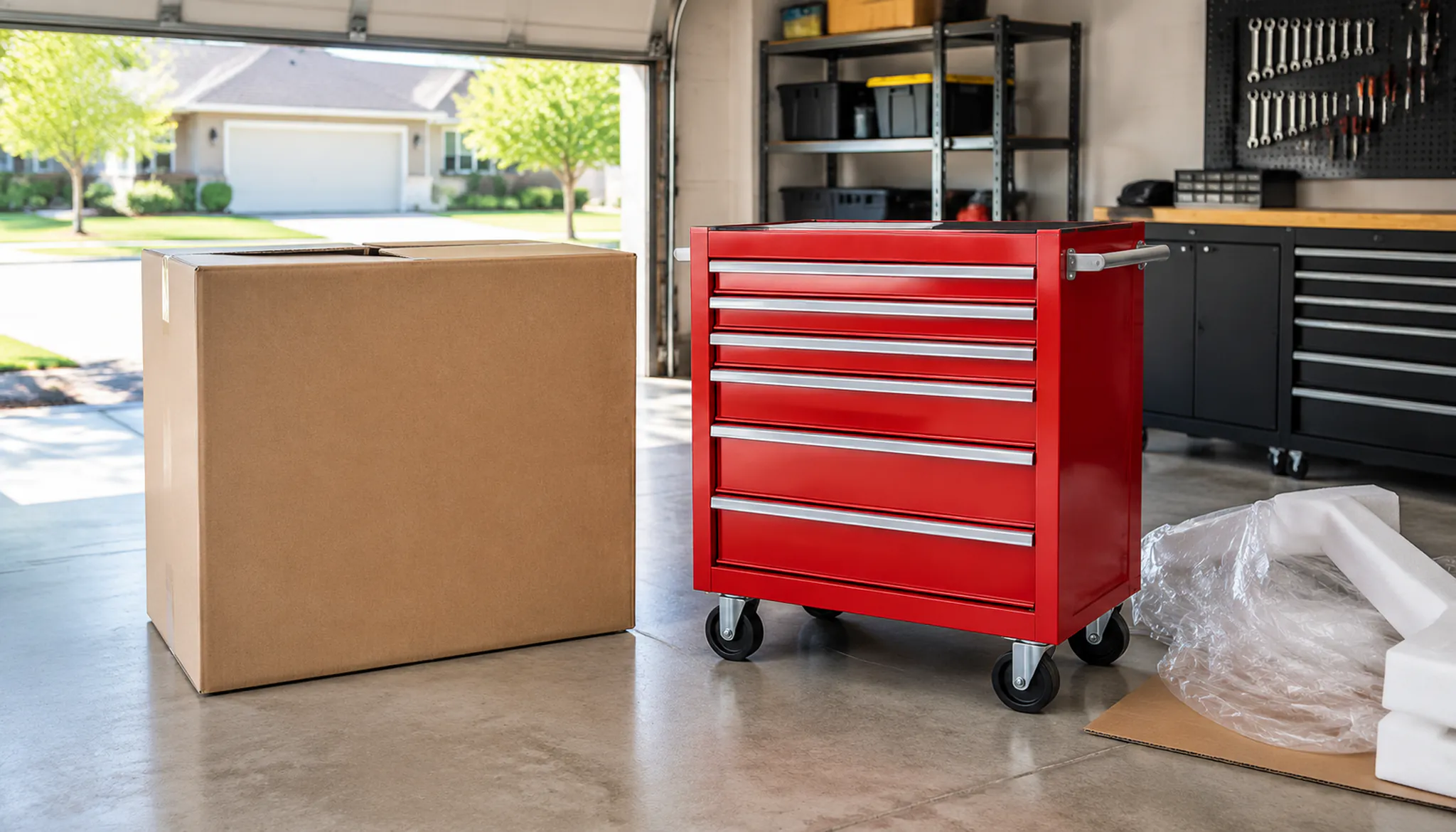
If you sell tool storage online, we also support one-piece dropshipping: you list the product, and we ship each order directly to your customer with DDP. That lets you test demand without holding inventory. DDP covers the USA, Canada, Europe, Australia, New Zealand and South America; send us the delivery address and we will confirm it.
FAQ
What is the best tool storage system for a professional workshop? There is no single best system. For most professional workshops it is a modular set built around a rolling tool cabinet, with an optional top chest, side cabinet or workbench, specified by steel thickness, slide rating, total load and casters that match the tool weight and floor conditions.
What steel thickness is good for a rolling tool cabinet? For professional and industrial use, buyers commonly specify around 1.0-1.2 mm (about 18-20 gauge) for drawers and side panels and around 1.5 mm (about 16 gauge) for load-bearing parts. Always state thickness in millimeters for each part in the RFQ.
Is a 100 lb drawer slide rating per drawer or per slide? It is normally quoted per drawer, meaning the pair of slides together, but suppliers use different conventions. Ask the factory to confirm how the rating is defined and how it was tested.
How do I size casters for a rolling tool cabinet? Estimate the fully loaded weight (empty weight plus tools), then divide it by fewer casters than are fitted, for example three of four, to allow for uneven floors. Larger diameters roll more easily over cracks and cables.
Can a rolling tool cabinet be customized for private label? Yes. Common adjustments include color, logo, drawer layout, lock package, worktop, casters and carton design. Lock these in the RFQ before sample approval.
Can I buy a single tool cabinet with door delivery, or use dropshipping? Yes. Many SAFEWELL models are in stock and can be bought as a single unit. We support one-piece dropshipping for online sellers and ship DDP to the USA, Canada, Europe, Australia, New Zealand and South America, so the cabinet arrives at the door with duties and customs handled. Send the delivery address to confirm.
Sources
- SAFEWELL LZ001 product page: https://www.swtoolstorage.com/products/lz001-professional-rolling-tool-cabinet/
- SAFEWELL LZ002-02 product page: https://www.swtoolstorage.com/products/lz002-02-heavy-duty-tool-cabinet-15-drawers/
- SAFEWELL OEM/ODM: https://www.swtoolstorage.com/oem-odm/
- SAFEWELL Contact: https://www.swtoolstorage.com/contact/
Related Reading
Continue with a few closely related product, OEM, and comparison pages.
- Tool Storage Product Range - Compare tool cabinet, tool cart, and modular storage options.
- OEM/ODM Program Overview - Review manufacturing workflow, sampling, and quality checkpoints.
- Tool Cabinet Manufacturer Audit Checklist: 12 Points to Vet a Factory in China - Read another related article from SAFEWELL News.
- Tool Box Wholesale Buying Checklist - Read another related article from SAFEWELL News.
Why SAFEWELL Is a Practical Fit
If you are building a tool storage system program, SAFEWELL publishes basic configuration data for its rolling cabinets so buyers can start from a known baseline:
- Two reference platforms: LZ001 for a compact professional rolling cabinet with 350 kg total capacity, and LZ002-02 for a 15-drawer heavy-duty cabinet with lighting, a PDU and up to 690 kg total capacity.
- Common adjustments: both product pages list drawer layout, worktop style, lock package, wheel configuration, logo placement and carton design.
- Inspection checkpoints: the product pages list incoming checks for steel thickness and purchased hardware, in-process checks for slide performance, caster installation and lock alignment, and a final outgoing inspection.
- Full system range: besides rolling cabinets, we make tool carts, workbenches, tool chests and tool boxes, so a complete storage system can come from one factory.
- Certifications and track record: ISO 9001:2015, ISO 14001:2015 and ISO 45001:2018 certificates, UL, CE and SGS certifications listed on our homepage, and a 98.7% on-time delivery rate.
- Response: most standard inquiries get a first reply within one business day (Contact page).
Many of our models are in stock and can be ordered as a single unit, and we also accept small-batch trial orders. For volume orders, our standard MOQ is one 20GP container, and you can mix different models in one container. We can ship DDP (delivered duty paid) to the USA, Canada, Europe, Australia, New Zealand and South America, so goods arrive at your door with customs clearance, duties and freight handled on our side. Send us your exact delivery address and we will confirm DDP for it. Samples are charged and typically take about 10 days, and mass production usually takes around 30 days after sample approval, depending on configuration. LZ001 is listed in red, blue and black, and the OEM/ODM page lists tailored color as a private-label option.
Send us your target size, drawer layout, load expectation, caster preference and market. We will reply with a recommended platform, customization options and a preliminary quotation.
Request a factory price for LZ001 · Request a factory price for LZ002-02 · Contact the project team
Prepared by SAFEWELL Industrial Content Team.