
Tool storage warranty returns claims terms should be locked before sample approval, not after the first damage report. Industrial distributors should define warranty scope, return triggers, claim evidence, replacement parts, packaging responsibility, and response timelines in the RFQ and purchase agreement. This reduces margin leakage when drawers, casters, locks, coatings, or cartons fail during distribution.
Key Takeaways
- Treat warranty, returns, and claims as commercial terms, not after-sales wording copied from a catalog.
- Confirm claimable defects by component: drawer slides, locks, casters, coating, welds, panels, cartons, and accessories.
- Require a claims pack format before shipment: batch number, photos, video if needed, defect quantity, and requested remedy.
- Tie return and credit terms to agreed QC checkpoints and export packaging evidence.
- For OEM/ODM programs, freeze the spec and spare-parts list before confirming MOQ, sample approval, and production lead time.
Why Tool Storage Warranty Returns Claims Terms Matter Before Supplier Replacement
Replacing a tool storage supplier is often triggered by visible problems: late delivery, carton damage, poor drawer alignment, weak casters, inconsistent coating, or slow refund handling. Public buyer feedback also shows recurring frustration around weak packaging, goods sold as available but delayed, and sellers resisting refunds. For distributors, these issues are not only service complaints; they become warehouse labor, credit notes, customer churn, and lost sell-through.
A distributor should therefore ask a simple question before awarding volume: if 3% of a container arrives with drawer-face rubbing, crushed corners, or failed locks, what exactly happens next? A supplier that cannot answer with dates, evidence requirements, and replacement routes is a commercial risk even if the unit price is attractive.
Warranty Scope Must Be Component-Level
A broad “one-year warranty” is not enough. Tool storage products include multiple failure points, and each should be covered or excluded clearly. Common component categories include:
- Drawer slides and drawer load rating
- Casters, brakes, axles, and mounting plates
- Lock cylinders, keys, and central locking bars
- Handles, hinges, gas struts, liners, pegboards, and accessories
- Welded joints, panels, shelves, and modular fit
- Powder coating, corrosion resistance, and finish consistency
- Cartons, corner protection, pallets, and moisture protection
For industrial distributors, the warranty should also state whether spare parts are free, discounted, or chargeable; whether labor is excluded; and whether the remedy is credit, replacement parts, partial shipment, or full replacement.
Recurring Buyer Friction Patterns
Field feedback and review patterns show several problems that repeat across tool and storage purchases. The details vary by seller, but the procurement lesson is consistent: poor packaging, unclear stock commitment, and weak after-sales response create avoidable disputes.
Packaging Failure Becomes a Warranty Dispute
A product may leave the factory in good condition but arrive with crushed corners, scratched drawer fronts, damaged locks, or loose hardware. If the purchase agreement does not define packaging responsibility, the supplier may argue that the issue is freight damage, while the buyer argues that the carton and internal protection were insufficient.
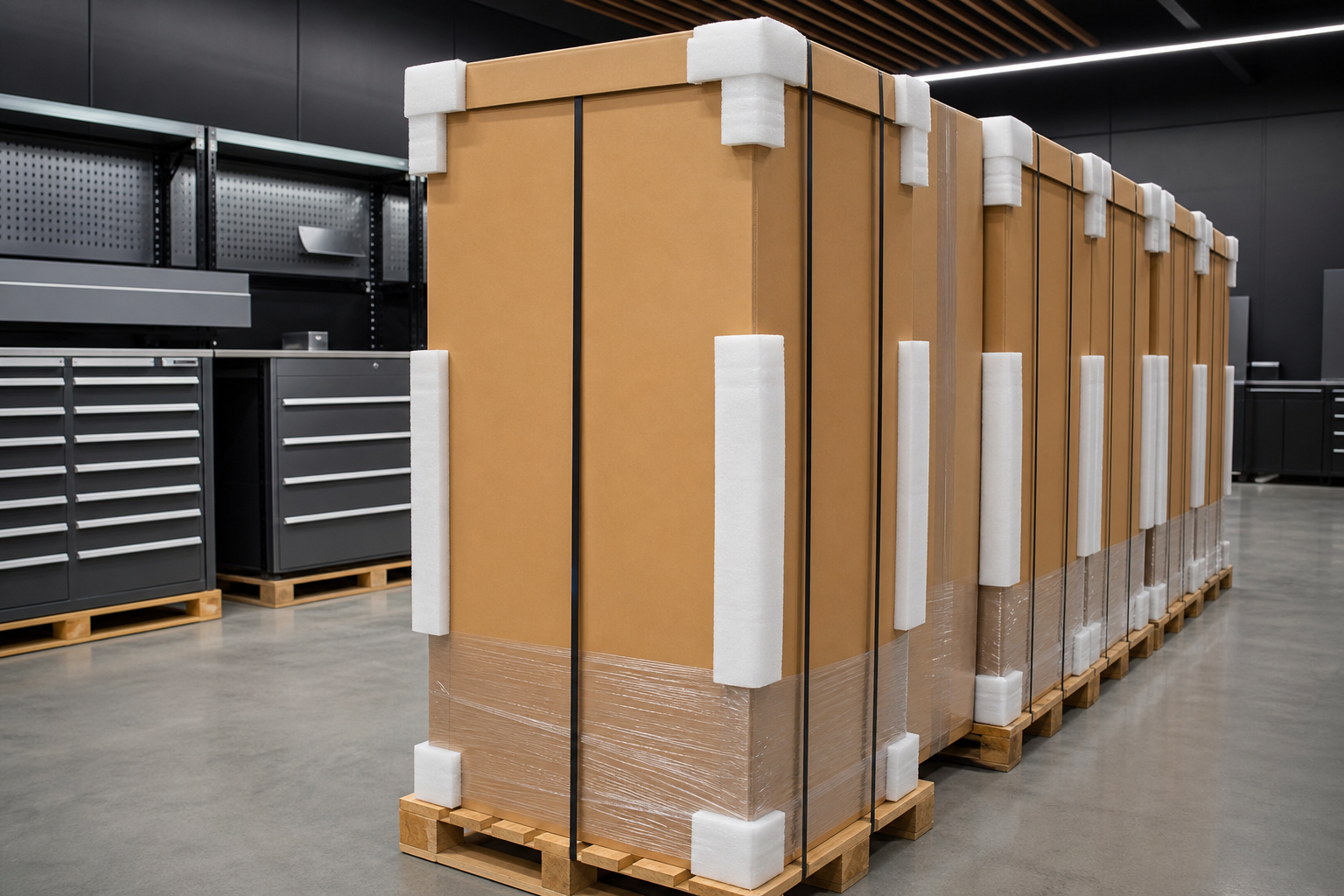
Distributors should ask for photos or video of packed samples, not only finished products. Export packaging requirements for tool storage cabinets should cover carton strength, foam or honeycomb corner protection, drawer movement restraint, pallet pattern, moisture protection, and container loading rules.
Delayed or Avoided Refunds Damage Distributor Confidence
Buyer complaints often escalate when sellers are slow to respond, dispute obvious defects, or make refund approval difficult. For B2B buyers, the solution is not to rely on goodwill. The RFQ should define a response window, such as initial claim acknowledgement within 2 working days and proposed corrective action within 5 working days after evidence is received.
“In Stock” or “Standard MOQ” Can Be Misleading
For OEM tool storage replacement parts warranty terms and custom distributor programs, stock and MOQ must be checked by SKU, finish, lock type, caster type, and accessory bundle. A black roller cabinet with one caster package is not the same commercial item as a two-tone version with upgraded drawer slides and private-label packaging.
SAFEWELL Procurement Watchpoints
SAFEWELL Note 1: MOQ and Spec-Lock Discipline
For industrial distributors, MOQ should be confirmed at the SKU + finish + accessory-bundle level, not only at the broad product-family level. Before sample sign-off, freeze drawings, coating code, lock and caster configuration, carton spec, and spare-parts list. If mixed-SKU or mixed-color loading is needed, request the supplier’s loading and MOQ rule set before assuming the first quoted MOQ applies to every combination.
A practical baseline for many metal tool storage projects is 100–300 units per SKU for standardized models and higher MOQ for custom colors, private-label cartons, or special accessory kits. Actual MOQ depends on tooling, coating line setup, material availability, and loading efficiency.
SAFEWELL Note 2: QC Watchpoints Buyers Should Put in Writing
Do not approve the RFQ until the supplier agrees on critical-to-quality items such as modular fit, shelf and drawer compatibility, drawer-slide performance, caster braking, lock function, coating thickness, and finish consistency across mixed configurations.
Ask who signs off IQC, IPQC, and OQC checkpoints. Also define which defects are claimable. For example, a small hidden coating mark may be a minor defect, while a bent drawer rail, failed lock, unstable caster, or carton corner crush affecting saleability should have a clear claim path.
SAFEWELL Note 3: Packaging and Claims Pitfalls
Packaging is a commercial-risk topic, not a late-stage admin task. Corner crush, drawer-face rubbing, and hardware damage usually become margin problems, not only warehouse problems.
Define a claims pack in advance: batch reference, carton label photo, product photo, defect close-up, quantity affected, PO number, requested remedy, response window, and spare-parts policy. For export-facing orders, confirm carton strength, pallet rules, moisture protection, and movement restraint before the first container leaves the plant.
Supplier Audit Scorecard
Use this scorecard when comparing incumbent suppliers, replacement suppliers, or shortlisted OEM/ODM factories.
| Audit Area | What to Verify | Buyer Risk if Weak | Recommended Evidence |
|---|---|---|---|
| Warranty scope | Component-level coverage for drawers, casters, locks, coating, welds, and accessories | Supplier rejects claims as “normal use” | Written warranty matrix |
| Returns policy | When returns, credits, replacement parts, or rework apply | Slow dispute resolution | Return and credit clause in quotation |
| Claims response | Acknowledgement and corrective action timeline | Open claims remain unresolved | Claims SOP with response windows |
| QC checkpoints | IQC, IPQC, OQC ownership and defect classification | Defects discovered only after arrival | Inspection report template |
| Packaging validation | Corner, drawer-face, lock, caster, pallet, and moisture protection | Transit damage and resale loss | Packing photos, drop-test or carton spec where applicable |
| Spare parts | Availability of locks, keys, slides, casters, handles, liners | Small defects require full-unit replacement | Spare-parts list and pricing |
| MOQ/spec control | MOQ by SKU, finish, bundle, and carton | Quote changes after sampling | Spec-lock sheet |
| Lead time | Sample, mass production, inspection, and shipment timing | Missed distributor launch window | Production schedule with milestones |
Procurement Checklist
Before issuing a purchase order or replacing a tool storage supplier, lock these points in writing:
- Confirm MOQ by SKU, finish, lock/caster configuration, accessory bundle, and packaging version.
- Freeze drawings, color code, coating requirements, drawer-slide specification, caster rating, and spare-parts list before sample approval.
- Request sample inspection records for drawer alignment, locking function, caster braking, surface finish, and modular compatibility.
- Define IQC, IPQC, and OQC checkpoints, including who signs off each stage and what evidence is shared.
- Agree on carton strength, corner protection, drawer restraint, pallet pattern, moisture protection, and carton labeling rules.
- Set production lead time assumptions, including sample revision time, material preparation, coating schedule, final inspection, and export booking.
- Define claimable defects, including functional failure, visible finish defects, packaging failure, missing accessories, and wrong labeling.
- Require a claims pack format with batch reference, photos, quantities, carton label, and requested remedy.
- Set after-sales response windows for acknowledgement, investigation, corrective action, credit, or replacement parts.
- Clarify warranty exclusions such as misuse, overload, unauthorized modification, abnormal corrosion exposure, or freight damage outside agreed packaging terms.
- Confirm whether replacement parts can ship with the next order or by urgent parcel shipment for distributor-critical cases.
Buyer Questions Before RFQ
1. What warranty applies to each tool storage component?
Ask for a component-level warranty matrix, not a single sentence. This reduces dispute risk when drawer slides, locks, casters, coating, or welded parts fail under normal use.
2. What evidence must we submit for a tool cabinet claims process for bulk orders?
Request a written claims pack format covering PO number, batch number, carton label, photos, defect quantity, and remedy requested. This prevents the supplier from changing evidence requirements after a problem appears.
3. How are damaged cartons and transit-related defects handled?
Ask whether packaging failure is claimable when carton design or internal protection was supplier-approved. Request packing photos and protection details for corners, drawer faces, locks, casters, and accessories.
4. What is the normal lead time from sample approval to shipment?
Ask for separate timing for sample revision, material preparation, production, coating, final inspection, and export booking. A realistic range may be 30–60 days after spec lock for many standard or lightly customized programs, but complex OEM/ODM projects can take longer.
5. What spare parts are stocked for after-sales support?
Request a spare-parts list for keys, locks, drawer slides, casters, handles, liners, hinges, and hardware. This helps distributors solve field claims without replacing full units.
What MOQ assumptions should buyers confirm before launching a tool storage warranty returns claims program?
Buyers should confirm MOQ at the SKU, finish, accessory-bundle, and packaging level rather than assuming one product-family MOQ applies to every combination. Ask whether sample orders, mixed finishes, or private-label packaging change the MOQ, because these details often affect quotation accuracy and lead time.
Relevant Standards & References
- ISO 9001 quality management systems: https://www.iso.org/iso-9001-quality-management.html
- ASTM D4169 distribution packaging performance testing: https://www.astm.org/d4169-22.html
- ISTA packaging test procedures: https://ista.org/test_procedures.php
- ISO 12944 corrosion protection of steel structures by protective paint systems: https://www.iso.org/standard/64834.html
- Incoterms rules overview from ICC: https://iccwbo.org/business-solutions/incoterms-rules/
Related Reading
Continue with a few closely related product, OEM, and comparison pages.
- Tool Storage Product Range - Compare tool cabinet, tool cart, and modular storage options.
- OEM/ODM Program Overview - Review manufacturing workflow, sampling, and quality checkpoints.
- Tool Box Wholesale Buying Checklist - Read another related article from SAFEWELL News.
- How to Launch a Tool Cart OEM Program - Read another related article from SAFEWELL News.
Why Buyers Use SAFEWELL as a Control Point
- OEM/ODM customization can be managed around locked drawings, coating codes, accessories, packaging, and spare-parts planning before production starts.
- RFQ support focuses on SKU-level MOQ, mixed loading, lead time, and claim terms rather than only unit price.
- QC coordination can include agreed checkpoints for modular fit, drawer operation, finish consistency, caster function, and export packaging.
- Claims handling can be structured around batch traceability, evidence packs, response windows, and replacement-part routes.
- Packaging discussions are brought forward during sampling to reduce avoidable damage and distributor credit exposure.
Prepare your target SKU list, annual volume estimate, finish requirements, lock/caster configuration, packaging expectations, and warranty requirements. Share your sample standard and the claim terms you want locked before order placement. SAFEWELL can help align the RFQ, sample confirmation, QC checkpoints, packaging plan, and OEM/ODM customization path before production commitment.
Contact SAFEWELL