
If you plan to buy tool chest products for resale, the safest path is to define the product class, load rating, drawer system, coating, locking method, packaging, and claims process before requesting final pricing. Many failed programs are not caused by price alone; they come from unclear specifications, weak packaging, inconsistent drawer performance, or late changes after sample approval. For B2B importers and distributors, a tool chest RFQ should read like a production control document, not just a product inquiry.
Key Takeaways
- Match the tool chest type to the channel: workshop storage, garage retail, mobile service, industrial maintenance, or bundled tool programs.
- Confirm MOQ at the SKU, color, finish, and accessory-bundle level before comparing supplier quotes.
- Treat drawer slides, anti-tip stability, lock fit, coating coverage, and carton protection as critical-to-quality items.
- Ask for export packaging evidence before mass production, not after goods reach the warehouse.
- Build a written warranty and claims flow covering batch traceability, spare parts, response time, and credit or replacement terms.
Buy Tool Chest Selection Starts With Use Case, Not Catalog Photos
A buyer should not begin with drawer count alone. The first decision is where the product will be used and how much abuse it must tolerate. A light consumer garage cabinet, a mobile mechanic chest, and an industrial maintenance tool chest may look similar online, but their RFQ requirements are different.
Buyer feedback across the market repeatedly points to the same failure themes: thin metal, drawer slides that lose smoothness, damaged packaging, and unclear after-sales handling. These issues are especially risky for distributors because a low ex-factory price can become expensive when replacements, warehouse sorting, or customer credits are added later.
Product format and channel fit
Common B2B tool chest formats include:
- Top chests for benches and combo sets
- Rolling cabinets with casters
- Portable tool chests with drawers for mobile service users
- Side cabinets and add-on storage modules
- Workbench cabinets with pegboard, power strip, or back panel options
- OEM bundled storage for tool brands or promotional programs
For a portable tool chest with drawers, the buyer should pay closer attention to handle strength, drawer retention during transport, lock security, and packaging restraint. For a stationary workshop cabinet, drawer load rating, caster quality, anti-tip behavior, and powder coating durability may carry more weight.
Specification depth needed before pricing
At RFQ stage, ask the supplier to confirm steel thickness range, drawer quantity, slide type, static and dynamic load rating, caster size, coating process, lock type, handle configuration, net weight, gross weight, carton dimensions, and pallet loading. If any of these fields are missing, price comparison becomes unreliable.
Where RFQs Usually Break Down
Tool chest RFQs often look complete on the surface but fail when the buyer and supplier interpret details differently. The most common gaps are finish code, slide quality, lock configuration, packaging strength, and spare-parts responsibility.
Late specification changes
Changing color, logo placement, slide grade, caster type, or carton design after sample approval can reset cost, lead time, and production planning. A supplier may still accept the change, but the result is often a rushed schedule or unclear accountability.
Weak QC language
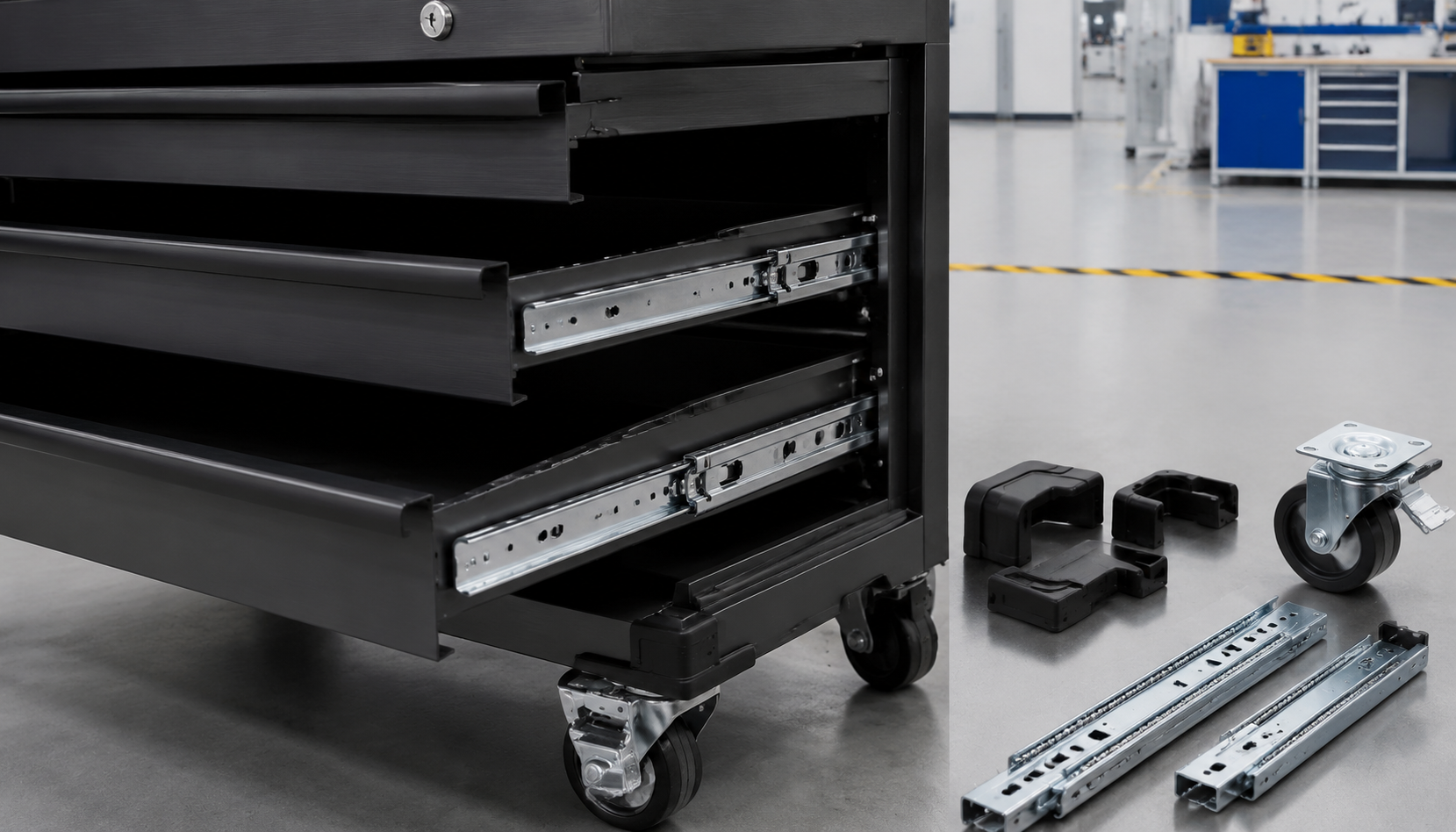
Many RFQs ask for “good quality” without defining measurable inspection points. That is not enough for metal storage products. Drawer gap alignment, slide smoothness, coating coverage on corners, lock engagement, caster braking, and anti-tip performance should be written into the purchase file.
Packaging treated as an afterthought
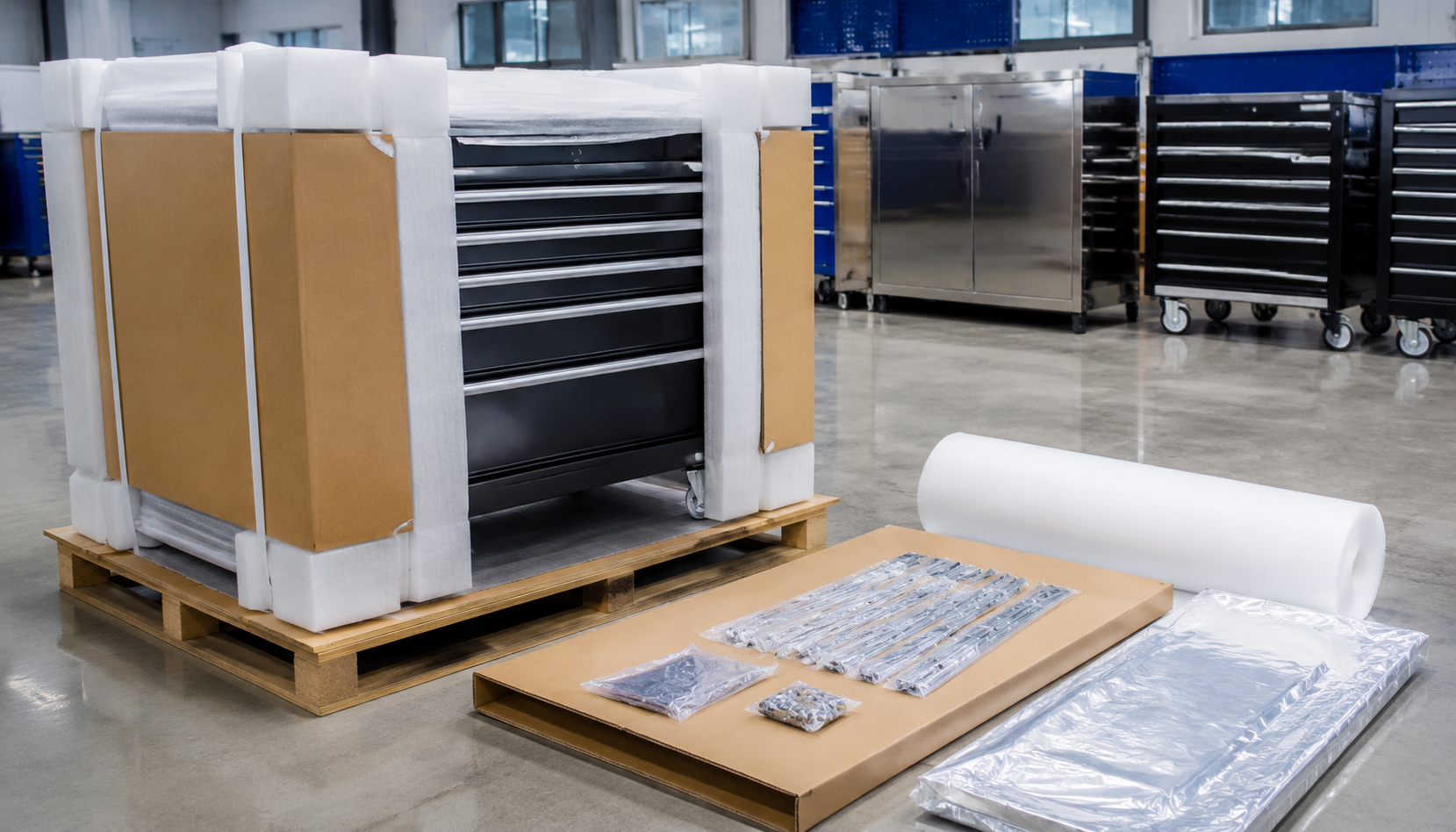
Tool chests are heavy, metal-faced products with corners, drawer fronts, and hardware that can be damaged in transit. If the carton, foam, corner protection, pallet layout, and movement restraint are not defined, the distributor may inherit claims that were preventable.
SAFEWELL RFQ Risk Notes
SAFEWELL Note 1: MOQ and spec-lock discipline
For industrial distributors, MOQ should be confirmed at the SKU, finish, and accessory-bundle level rather than only at the product-family level. A supplier may quote one MOQ for a standard black rolling cabinet but apply a different MOQ for mixed colors, private label logo plates, special casters, or drawer liner bundles.
Before sample sign-off, freeze drawings, coating code, lock and caster configuration, carton specification, and spare-parts list. If mixed-SKU or mixed-color container loading matters, ask for the supplier’s loading rule set up front. This prevents quote changes from spilling into lead time.
SAFEWELL Note 2: QC watchpoints to put in writing
Do not approve the RFQ until the supplier agrees on critical-to-quality items. These include drawer gap alignment, slide consistency, anti-tip behavior, lock system fit, caster brake function, powder coating edge coverage, and visible surface defects.
Ask for photo or video evidence of coating around drawer fronts, corners, and high-touch zones. These are common claim areas because they are visible to end users and easy to damage if process control is weak.
SAFEWELL Note 3: Packaging and claims prevention
Treat packaging as a commercial-risk topic. Corner crush, drawer-face rubbing, bent handles, damaged casters, and missing hardware usually become margin problems, not just warehouse complaints.
Define the claims pack before shipment: batch reference, defect photos, carton photos, response window, spare-parts policy, and credit or replacement path. This reduces after-sales friction when defects appear in the market.
Supplier Audit Scorecard
Use this scorecard to compare suppliers before placing a sample order or trial PO.
| Audit Area | What to Verify | Buyer Risk if Missed | Suggested Evidence |
|---|---|---|---|
| Product engineering | Steel thickness, drawer load, slide type, caster rating | Product feels weak or fails under use | Drawings, load test records, sample check |
| Coating process | Powder coating code, pretreatment, edge coverage | Rust, chips, visible finish claims | Coating photos, process notes, salt spray data if applicable |
| Drawer performance | Smooth movement, gap consistency, retention | Poor user experience and returns | Video inspection, AQL report, sample test |
| Lock and safety | Lock fit, key system, anti-tip function | Security complaints or safety risk | Functional test record |
| Packaging | Carton strength, foam, corner guards, pallet rules | Freight damage and warehouse sorting cost | Drop test plan or packing photos |
| MOQ and customization | MOQ by SKU, color, logo, accessory bundle | Quote changes after approval | Written MOQ matrix |
| Export readiness | Labeling, carton marks, destination rules | Customs or channel delays | Artwork approval, carton layout |
| Claims support | Spare parts, response time, credit path | Slow after-sales resolution | Written warranty and claims procedure |
Procurement Checklist
Before you buy tool chest products at volume, include these points in the RFQ and supplier confirmation:
- Define target channel, application, load expectations, and retail or industrial positioning.
- Confirm MOQ by SKU, finish, logo option, caster type, and accessory bundle.
- Request drawings with dimensions, steel thickness assumptions, drawer count, and net/gross weight.
- Approve sample against drawer slide smoothness, drawer gap, lock fit, caster function, and coating finish.
- Require IQC, IPQC, and OQC checkpoints with named sign-off responsibility.
- Define acceptable and claimable defects, including coating chips, bent panels, rubbing marks, and missing parts.
- Confirm carton strength, inner protection, pallet rules, moisture protection, and container loading method.
- Check labeling needs for carton marks, SKU barcodes, private label, warnings, and destination compliance.
- Lock lead time assumptions for sample, tooling or fixture adjustment, mass production, inspection, and shipment.
- Agree warranty period, spare-parts policy, claim evidence requirements, and response window.
OEM/ODM Options That Affect Cost and Lead Time
OEM/ODM customization is valuable for distributors, but every change should be tied to MOQ, production complexity, and inspection requirements.
Typical options include private label logo, color matching, drawer liner type, handle design, caster grade, lock system, packaging artwork, carton barcode, tool tray layout, and accessory kits. For standard models, a practical MOQ may start in the low hundreds per SKU, but custom colors, non-standard packaging, and unique hardware may require higher MOQ. Lead time commonly depends on sample approval, material availability, coating schedule, and container planning; buyers should request a supplier-specific timeline rather than assuming a fixed industry number.
If your program includes several sizes, ask whether mixed loading is allowed and whether each model can share the same finish and packaging system. This can reduce complexity and simplify after-sales parts management.
Buyer Questions Before RFQ
What load rating should we request for each drawer and caster?
Ask the supplier to separate drawer load, total cabinet load, and caster load. Request test method notes or internal load test records so your team can judge whether the model fits workshop, garage, or industrial maintenance use.
How do we compare metal tool chest drawer slide quality inspection results?
Request a sample video showing loaded drawer operation, full extension behavior if applicable, gap consistency, and closing feel. Also ask whether slide defects are checked during IPQC or only at final inspection.
What export packaging should be confirmed before mass production?
Ask for carton specification, inner foam or corner protection, pallet stacking method, moisture protection, and photos of a packed sample. This reduces the risk of drawer-face rubbing, corner crush, and hardware damage.
Can we customize color, logo, and accessories without changing MOQ?
Do not assume yes. Ask for an MOQ matrix by color, logo method, caster option, liner type, and accessory bundle. This prevents a low standard MOQ from being mistaken for a custom-program MOQ.
What warranty and spare-parts policy should a distributor request?
Request a written policy covering claim evidence, batch traceability, response window, spare parts, replacement parts, credits, and freight responsibility. This protects the distributor when failures appear after local delivery.
What MOQ assumptions should buyers confirm before launching a buy tool chest program?
Buyers should confirm MOQ at the SKU, finish, accessory-bundle, and packaging level rather than assuming one product-family MOQ applies to every combination. Ask whether sample orders, mixed finishes, or private-label packaging change the MOQ, because these details often affect quotation accuracy and lead time.
Relevant Standards & References
These references can help buyers frame safety, packaging, and quality expectations. Applicability depends on destination market and product configuration.
- ISO 9001 quality management overview: https://www.iso.org/iso-9001-quality-management.html
- ASTM D4169 distribution packaging test practice: https://www.astm.org/d4169-22.html
- ISTA packaging test procedures: https://ista.org/test_procedures.php
- EU REACH chemicals regulation: https://echa.europa.eu/regulations/reach/understanding-reach
- U.S. Consumer Product Safety Commission business guidance: https://www.cpsc.gov/Business--Manufacturing
Related Reading
Continue with a few closely related product, OEM, and comparison pages.
- Tool Storage Product Range - Compare tool cabinet, tool cart, and modular storage options.
- OEM/ODM Program Overview - Review manufacturing workflow, sampling, and quality checkpoints.
- What Tool Storage Warranty, Returns, and Claims Terms Buyers Should Lock In Upfront - Read another related article from SAFEWELL News.
- Tool Box Wholesale Buying Checklist - Read another related article from SAFEWELL News.
How SAFEWELL Supports RFQ Execution
- OEM/ODM specification support: drawings, finish options, logo placement, accessory bundles, and packaging files can be aligned before sample approval.
- MOQ clarification: SKU, color, finish, and bundle-level MOQ can be separated so buyers understand real ordering constraints.
- QC planning: drawer alignment, slides, coating, lock fit, caster function, and packaging checks can be written into the inspection file.
- Export packaging coordination: carton, pallet, moisture protection, and container movement restraint can be reviewed before shipment.
- Claims workflow: spare-parts lists, batch reference, photo evidence, response window, and replacement or credit paths can be defined early.
Prepare a tool chest RFQ package with drawings, target use case, load requirements, finish code, logo needs, packaging expectations, QC checkpoints, MOQ assumptions, and claims terms. Send the package with your target market, estimated annual volume, preferred delivery schedule, and sample requirements so SAFEWELL can review feasibility and return a structured OEM/ODM quotation.
Contact SAFEWELL