For global brands, sourcing a private-label tool cart from China provides access to a world-class manufacturing base and a deep supply chain. However, navigating the vast supplier landscape to find a reliable OEM/ODM partner requires a structured vetting process. Success depends on moving beyond catalog prices to verify a factory's technical capabilities, quality systems, and customization expertise. This guide provides a framework for brand owners to conduct due diligence and select a manufacturer capable of delivering a product that meets precise quality and brand standards.
Quick Navigation
Why a Systematic Vetting Process is Crucial
A tool cart is more than a steel box on wheels; it's a functional asset that represents your brand's promise of quality and durability. A partnership with an unqualified supplier can lead to critical product failures—such as caster collapse, drawer slide malfunction, or premature rusting—that damage brand reputation and result in costly returns. A systematic approach to vetting mitigates these risks and establishes a foundation for a long-term, profitable partnership.
Key Verification Framework for a Tool Cart OEM Partner
Before engaging potential suppliers, establish clear evaluation criteria. A durable, high-performance tool cart depends on verifiable quality at every stage of production.
1. Engineering and Design Capabilities
A true OEM/ODM partner functions as an extension of your product development team. Assess their engineering depth:
- Design Collaboration: Do they have an in-house engineering team proficient in CAD software (e.g., SolidWorks, AutoCAD)? Can they work from your technical drawings or collaborate to create new designs?
- Prototyping Process: A clear, efficient process for creating and refining pre-production samples is essential. This is your opportunity to test the design, fit, and function before committing to mass production.
- Problem-Solving: Can they suggest material or design modifications to meet a specific price point or performance target?
2. Material and Component Control
The foundation of a quality tool cart is its material and components. Do not accept vague terms like "high-quality steel."
- Steel Specification: Request material data sheets. The standard is SPCC-grade cold-rolled steel. Verify the gauge (thickness); a professional-grade cart might use 1.0-1.2mm (19-18 gauge) steel for the frame and 0.8-1.0mm (22-19 gauge) for drawers.
- Component Sourcing: Inquire about the source and specifications of critical components. This includes ball-bearing drawer slides (ask for load rating and cycle life), casters (material, diameter, load capacity), and locking mechanisms.
3. Production Technology and Finishing
Modern production facilities ensure consistency and quality at scale.
- Fabrication Technology: Look for advanced equipment like CNC laser cutters for precision parts and robotic welding for consistent, strong seams.
- Finishing Process: A durable powder coat finish requires proper surface pre-treatment (e.g., a multi-stage phosphating wash). Verify the coating thickness, which should typically be 60-80 microns to resist scratches, chemicals, and corrosion.
4. Quality Management and Compliance
A reputable manufacturer operates within a documented quality system.
- Certifications: ISO 9001:2015 is the baseline, confirming a structured quality management system. A recent BSCI report demonstrates social compliance.
- QC Checkpoints: Ask for their QC process map. It should include Incoming Quality Control (IQC) for raw materials, In-Process Quality Control (IPQC) at fabrication stages, and Final Quality Control (FQC) during assembly and packaging.
- Load Testing: The manufacturer must be able to prove their load capacity claims. Ask for internal reports or videos of static and dynamic load tests on the frame, drawers, and casters.
Decision Matrix for Supplier Vetting
Use this table to score and compare potential partners during your evaluation process.
| Evaluation Criterion | Green Flag (Positive Indicator) | Red Flag (Warning Sign) |
|---|---|---|
| Engineering Collaboration | Has an in-house engineering team; provides design feedback. | Can only offer standard catalog items with logo printing. |
| Material Specification | Provides detailed material certificates (e.g., SPCC) and confirms steel gauge. | Uses vague terms like "heavy-duty steel" with no technical data. |
| Component Transparency | Can provide options and specifications for slides and casters. | Cannot explain the difference between component options or their load ratings. |
| Quality Certification | Readily provides a valid ISO 9001:2015 certificate and recent BSCI report. | No certifications, or certificates are expired or from an unknown body. |
| QC Documentation | Shares their QC process map and can provide testing reports. | Resists requests for quality documentation or factory audits. |
| Factory Audit | Welcomes a third-party or buyer audit (in-person or virtual). | Is hesitant or refuses requests for a factory tour or detailed production videos. |
Why SAFEWELL Is a Practical Fit for Private Label Brands
For brand owners who prioritize product differentiation and supply chain reliability, SAFEWELL offers a direct and practical partnership path that aligns with the rigorous vetting criteria outlined above.
Their core strength is a deep, process-driven OEM/ODM capability. Unlike factories that simply re-brand catalog items, SAFEWELL's engineering team is structured to collaborate with clients on new designs, from initial drawings to functional prototypes. This allows your brand to specify critical performance attributes:
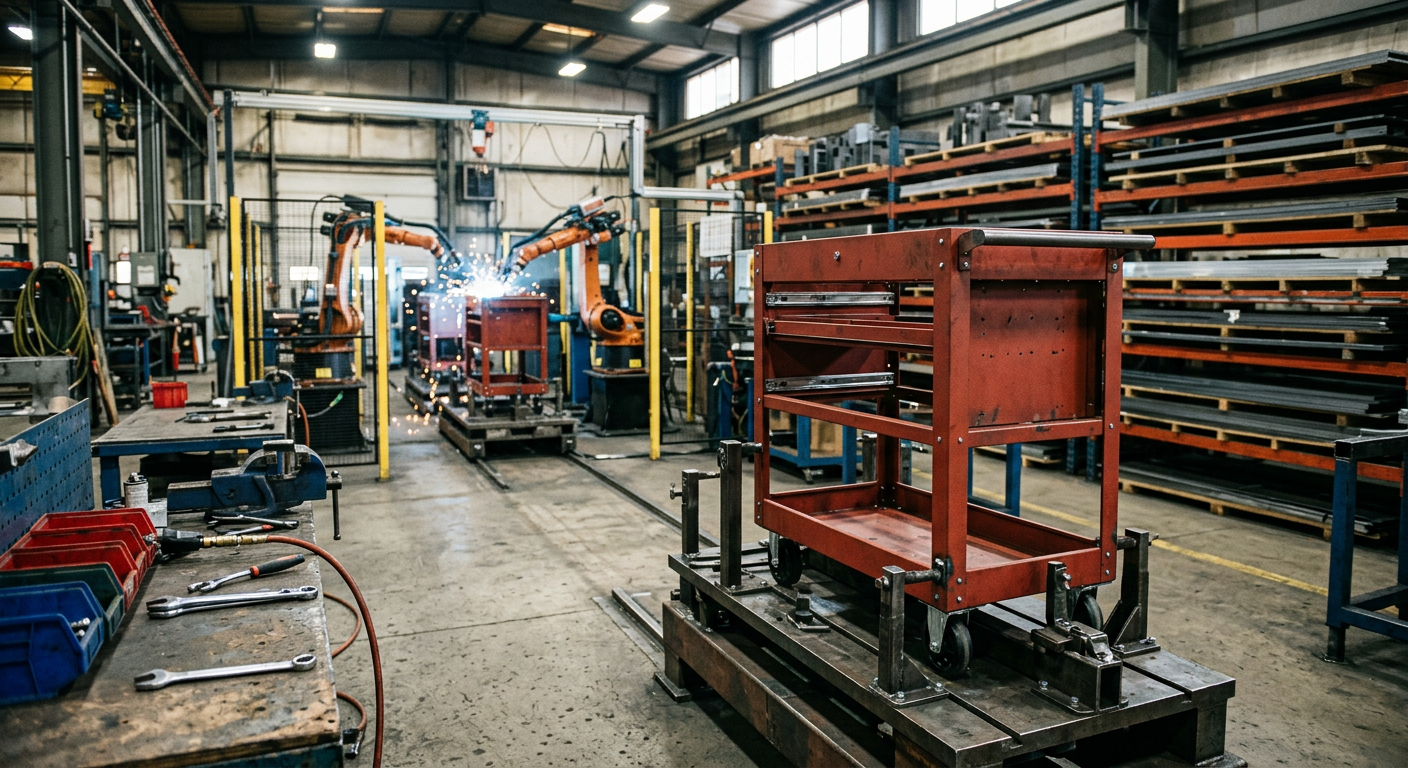
- Customized Construction: Define the exact steel gauge for the frame and drawers to meet specific durability and price points, with engineering feedback to ensure structural integrity.
- Vetted Component Selection: Choose from a curated range of components, including ball-bearing slides with different load ratings, caster types (swivel, fixed, locking), and various locking systems to match your product tier.
- Brand-Specific Features: Integrate unique elements like custom drawer liner materials, specific handle designs, integrated power strips, or proprietary color schemes using their advanced powder coating line.
SAFEWELL's extensive experience exporting to regulated markets in North America and Europe means they are proficient in meeting international quality and packaging standards (e.g., ISTA-3A for parcel shipping), significantly reducing logistical risks for global buyers.
Next Step: Start Your RFQ
Armed with this framework, the next actionable step is to prepare a detailed Request for Quotation (RFQ). A well-crafted RFQ, based on the verification criteria above, ensures you receive accurate, comparable proposals and immediately filters out unqualified suppliers.
Your RFQ should include: * Product Specification: Technical drawings or detailed sketches with dimensions. * Material Requirements: Specify steel grade (e.g., SPCC) and thickness for the frame and drawers. * Component Performance: Define drawer and caster load capacity requirements. * Features & Finish: List desired features (locking system, handle type) and finish requirements (color, texture). * Commercial Details: Target order quantity, desired timeline, and packaging requirements.
Contact a proven OEM/ODM specialist like SAFEWELL to begin this process. Their engineering team can provide a technical assessment of your requirements and a detailed quotation, putting you on the most direct path to launching a tool cart that reflects your brand's commitment to quality.
FAQ
What is a typical MOQ for a custom tool cart order in China?
Minimum Order Quantities (MOQs) vary by manufacturer and complexity. For a fully custom design or significant modifications, expect an MOQ between 100-200 units. For private-labeling an existing design with minor changes (e.g., color, branding, handles), MOQs can be as low as 50 units. Always confirm with the specific supplier.
What are the main cost drivers for an OEM tool cart?
The primary cost factors are: 1) Steel weight, determined by the cart's dimensions and steel gauge (thickness). 2) Component quality, especially the load rating and smoothness of drawer slides and casters. 3) Locking system complexity. 4) Finish quality, including powder coating thickness and surface pre-treatment. 5) Packaging complexity, especially if it needs to meet ISTA standards for e-commerce.
How can I protect my brand's intellectual property (IP) with a Chinese OEM?
Work with established manufacturers who have a reputation to protect. Before sharing sensitive designs, sign a comprehensive NNN (Non-Disclosure, Non-Use, Non-Circumvention) agreement that is written to be enforceable in China. Registering your trademarks and any applicable design patents in China is also a critical protective measure.
What is a realistic timeline for a new tool cart project?
A typical timeline from design finalization to shipment is 90-120 days. This generally breaks down into: 30-45 days for design refinement and prototyping, 45-60 days for mass production after sample approval, and 15 days for final inspection, packaging, and delivery to the port.
What quality certifications are most important for a tool cart manufacturer?
ISO 9001:2015 is the most critical certification, as it validates the factory's quality management system. For social compliance, look for a recent BSCI (Business Social Compliance Initiative) audit report. ISO 14001 indicates a commitment to environmental management.
Sources
Related Internal Resources
Use these pages to continue supplier qualification and project planning.
- Tool Cart Solutions - Review rolling cart options and capacity classes.
- OEM/ODM Program Overview - Review manufacturing workflow, sampling, and quality checkpoints.
- Project Case Studies - See delivered projects and implementation details for global buyers.
- Request Factory Quote - Send your RFQ and receive a practical sourcing proposal.
- How to Qualify a Tool Box Manufacturer for OEM Programs - Read another related article from SAFEWELL News.
Need a Factory Plan?
Share your RFQ and we will provide a practical manufacturing proposal.
Contact SAFEWELL